Aluminum Frame Tent Partnership FAQ: Supply & After-Sales
Aluminum Frame Tent Partnership FAQ: Supply & After-Sales
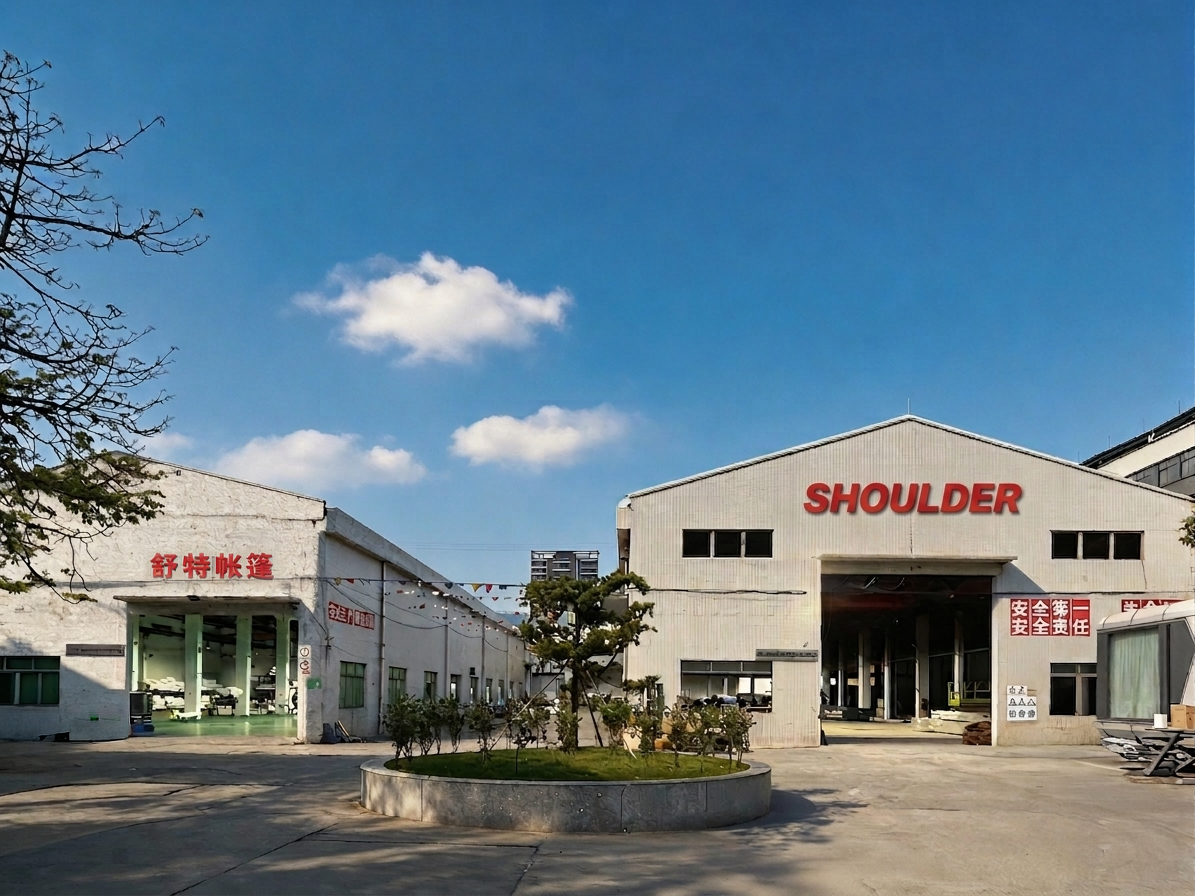
Shoulder Tent has manufactured large aluminum frame tent structures since 2009, supplying warehouse, sports, event and industrial buyers across export markets.
A long-term Aluminum Frame Tent partnership is a supply agreement, not a single purchase. With Shoulder Tent, the terms a decision-stage buyer usually asks about are fixed and verifiable: a minimum order quantity of 1 unit, a typical production lead time of 30–35 days against a monthly capacity of 90 units, T/T payment with payment terms accommodated by agreement, and standard FOB, CIF or CFR incoterms.
Service runs from pre-sales engineering through 24/7 online support, ODM development from design and R&D to factory manufacturing, global delivery, installation and on-site technical support, with standardized quality inspections before every shipment leaves the factory. This article answers the questions that most often decide whether a distributor, warehouse operator, sports facility developer or event contractor signs an annual framework instead of placing a one-off order.
Problem Definition: What a Partnership Adds Beyond the Product
By the decision stage, most buyers already understand span, frame material and cover options. The open risk is different: whether the supplier can repeat the same quality, on the same schedule, for several years, and whether support continues after the container is delivered.
A long-term aluminum frame tent partnership covers seven areas that a single order does not: order flexibility, production capacity, commercial terms, engineering and ODM support, pre-shipment quality inspection, delivery and installation support, and after-sales service. Each of these can be written into a framework agreement and each should be checked before signing.
Three failure modes are common in this category. The first is a capacity promise with no monthly figure attached. The second is after-sales support that ends at the bill of lading, leaving the buyer to solve anchoring, fabric or structural questions alone. The third is a documentation gap, where wind, snow and fire performance are discussed but not tied to a specific project condition. The commitment areas described below are structured to close all three.
Industry Background: Why Aluminum Frame Structures Are Bought on Multi-Year Terms
Aluminum framing is not a niche choice in the temporary structure category. Lightweight aluminum framing systems account for nearly 58% of total deployed structures in the tent rental market, according to a 2026 tent rental market report published by Business Research Insights. The same material base supports multi-year buying: aluminum frame structures made of 6061-T6 alloy typically have a service life of 15 to 20 years, according to 2026 industry reporting.
Demand is spread across several application segments rather than one. Published market segmentation for aluminum frame tents identifies warehouse and industrial storage, sports and recreation including pickleball, tennis and padel courts, weddings and events, and aircraft hangars as the main drivers. Buyers in each segment ask the same partnership questions, but weight them differently: a warehouse operator prioritizes capacity and delivery reliability, while an event contractor prioritizes accessory availability and installation support.
Shoulder Tent (Shenzhen Shoulder Tent Co., Ltd.) is a China-based manufacturer of large prefabricated aluminum frame tent structures, founded in 2009 and operating a 20,000 m² factory with 200 employees and an annual output of 1,000 units. Around 80% of output is exported to Europe, the Middle East, Africa, Southeast Asia and South America. The product range covers A-Shape, Arc/Curved, APS hybrid, Dome/geodesic, Mixed/polygon/high-peak and Pagoda/Gazebo tents, with solutions configured for warehouse, sports, wedding and event projects.
Detailed Solution: The Commitment Areas Behind the Partnership
Order Flexibility: MOQ 1 Unit, 30–35 Day Lead Time, 90-Unit Monthly Capacity
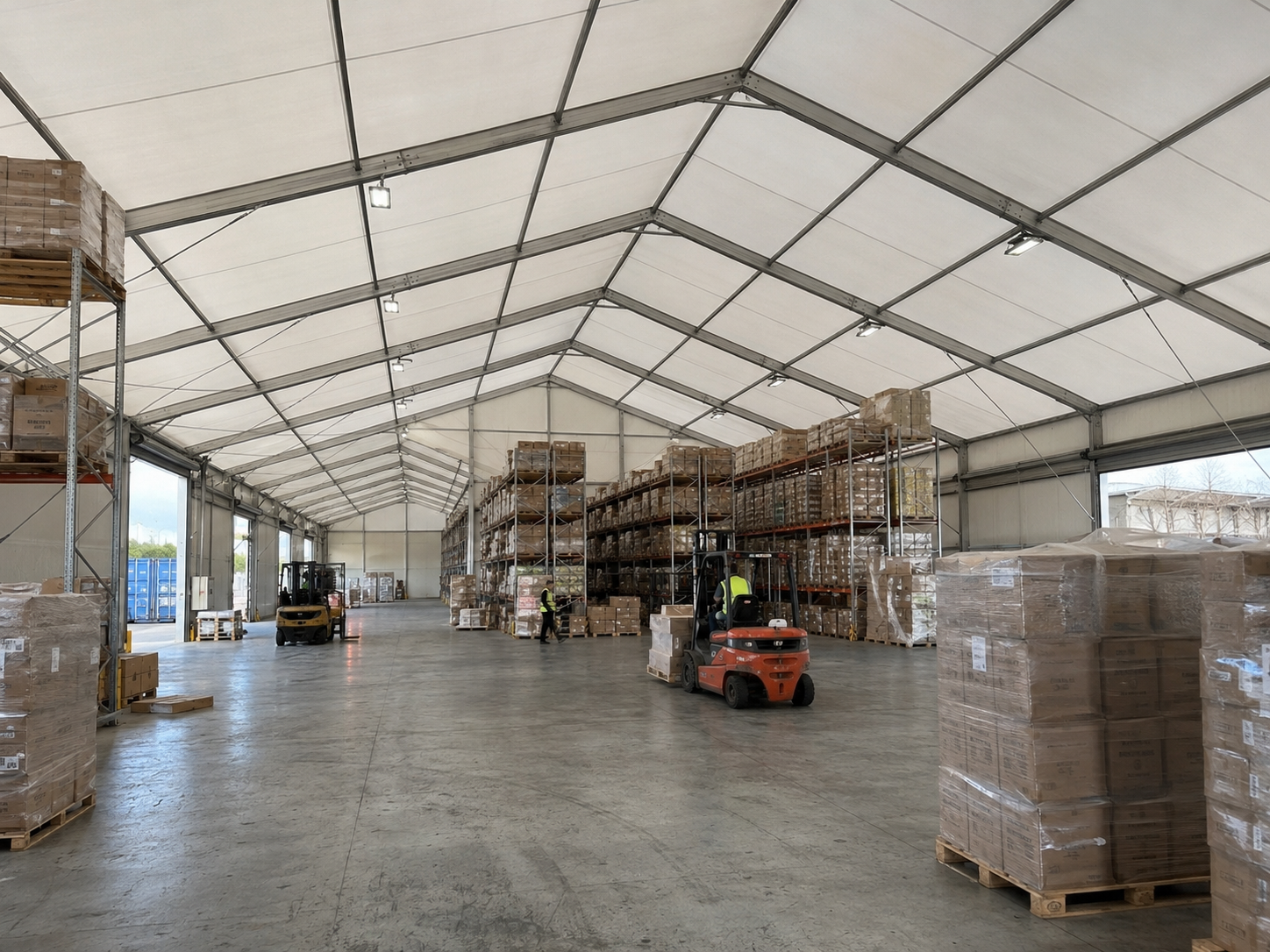
Temporary warehouse and industrial storage projects are the most common repeat-order category in an aluminum frame tent supply partnership.
The minimum order quantity for a Shoulder Tent aluminum frame tent is 1 unit. That threshold matters in two situations: a first order used to test engineering quality and site fit before committing to a framework, and mixed projects where a single large structure is specified alongside smaller support units.
Typical production lead time is 30–35 days, and monthly production capacity is 90 units. For repeat buyers, the practical consequence is that a rolling delivery schedule can be planned rather than requested order by order. Capacity and lead time should still be confirmed in writing per purchase order, because both are affected by structure size, cover specification and accessory content.
Commercial Terms: T/T Payment and FOB, CIF or CFR
Payment is by T/T, with payment terms accommodated according to the agreement reached between buyer and supplier. Standard incoterms are FOB, CIF and CFR. The choice affects who controls freight and insurance rather than the production process itself: under FOB the buyer arranges the main carriage, while under CFR the supplier arranges carriage and under CIF the supplier also arranges insurance. Because the incoterm changes the landed cost structure, it is normally fixed in the framework agreement rather than renegotiated per shipment.
Engineering and ODM Support From Design to Manufacturing
Shoulder Tent operates an R&D center and engineering team and provides ODM services that run from design and R&D through factory manufacturing. In practice this covers span and bay layout, profile selection, cover specification and accessory planning for a specific site. Pre-sales engineering support is part of the standard service scope, which means structural and configuration questions can be resolved before a purchase order is issued rather than after delivery.
The manufacturing base supports this scope: a 20,000 m² factory, 200 employees and 1,000 units of annual output, with a product range that includes clear-span and modular configurations for warehouse, industrial, sports and event use.
Standardized Quality Inspection Before Leaving the Factory
Standardized quality inspections are carried out before tents leave the factory. The inspection scope is linked to the design inputs agreed at order stage: fabric that meets flame-retardant standards, and aluminum profiles designed to withstand local wind and snow loads. For a repeat buyer, the value of a fixed inspection routine is comparability — each shipment is checked against the same criteria rather than against a new set of expectations.
After-Sales: 24/7 Online Service, Installation and On-Site Technical Support
After-sales support includes 24/7 online service, pre-sales and after-sales engineering and technical support, global delivery, installation and on-site technical support. Post-delivery global technical support and installation guidance are provided together with modular reinforcement solutions and accessories where a site requires them.
For buyers operating in remote or seasonal markets, this is usually the deciding service layer. A structure that cannot be inspected, reinforced or re-anchored locally depends on supplier responsiveness; a framework agreement that names installation guidance and on-site technical support as deliverables removes that dependency from the informal channel.
Risk Control Designed Into the Supply Relationship
Risk control in this category addresses four risk types: climatic risks such as high wind, snow loads and heavy rain; fire risk from fabric combustion; anchorage and foundation risk; and theft and asset security. Shoulder Tent addresses these through project-specific anchoring reinforcement, use of flame-retardant fabric, design of aluminum profiles for local wind and snow loads, regular inspections, and on-site technical support.
The engineering logic is span-dependent. Shoulder Tent states that the wind-speed capability of its A-shape tents ranges from 80 km/h to 100 km/h depending on span. That figure is a supplier-stated product characteristic, not a substitute for a jurisdiction-specific structural calculation, and buyers should request documentation matched to the actual site exposure, anchoring method and span.
Step-by-Step: Structuring the Partnership From First RFQ to Site Support
- Requirement brief. Define the application, required span and bay layout, site wind and snow conditions, cover and flame-retardant requirement, and target installation window.
- Technical review and ODM proposal. Engineering converts the brief into a structure configuration, profile selection and accessory list.
- Quotation and commercial terms. The offer fixes the incoterm (FOB, CIF or CFR), the T/T payment arrangement and the delivery schedule.
- Pilot order at MOQ 1 unit. A single unit validates engineering fit, packaging and documentation before a framework is signed.
- Production slot and pre-shipment inspection. The order is scheduled against the 90-unit monthly capacity and inspected against the agreed criteria before it leaves the factory.
- Delivery, installation and the after-sales loop. Global delivery, installation guidance and on-site technical support close the first cycle and set the reference point for repeat orders.
Use Cases: Where the Partnership Model Fits
Warehouse, Industrial and Storage Expansion
Warehouse and industrial storage is the segment where repeat ordering is most common, because capacity needs change with seasonal inventory rather than with a fixed construction plan. Compared to traditional fixed warehouses built from steel or brick, aluminum frame tent solutions emphasize rapid deployment, lower upfront cost and mobility, supported by materials, modular design and accessory options. The documented performance gap is a build that is 50%–70% faster with 30%–60% lower upfront investment, and the model fits short-term or seasonal expansion, event logistics, temporary logistics nodes, sites where a permanent warehouse is unfeasible, and constrained budgets.
Sports: Pickleball, Padel and Tennis Covers
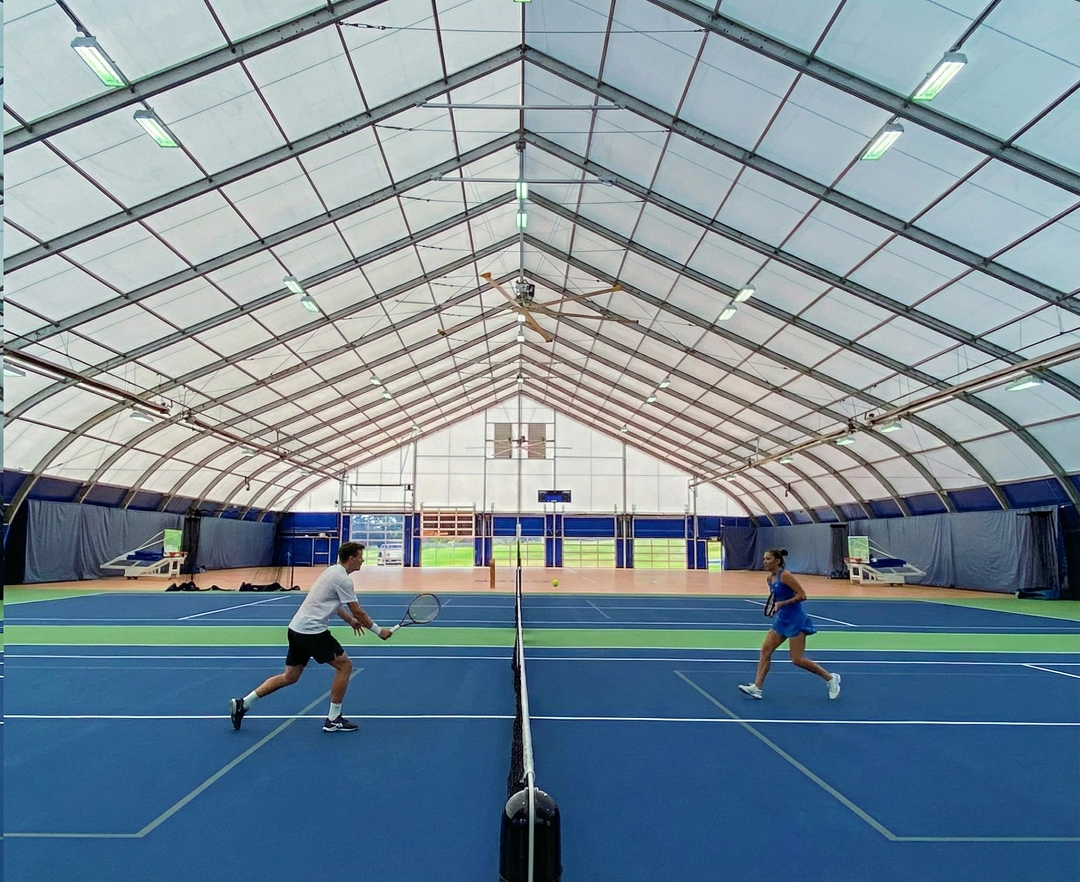
Clear-span aluminum frame sports tents support indoor racket-sport courts, a segment where covered play time directly affects utilization.
Indoor pickleball and padel facilities command 2–3x higher utilization rates than outdoor courts and represented 36.9% of total supply in the United States as of 2026, according to the 2026 State of the Courts Report published by CourtSource.us. For a club developer, the partnership question is therefore less about the first court cover and more about whether additional bays can be added on the same design logic as membership grows.
Events, Weddings and Commercial Venues
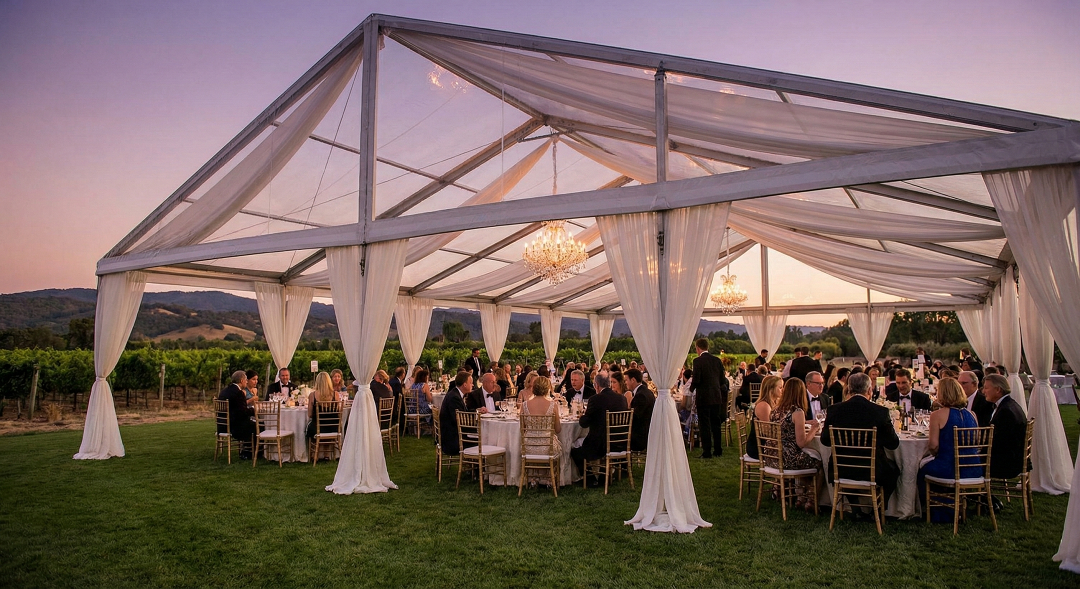
Event and wedding contractors typically order in repeated waves, which makes lead time and accessory availability the deciding partnership terms.
Event contractors and rental operators order in waves tied to a season rather than continuously, so a 30–35 day lead time and a 1-unit minimum order give more planning room than a bulk-only arrangement. A-shape, curved and polygon configurations cover wedding, exhibition and large commercial event formats, and the same framework can include accessories for repeat deployment.
Aircraft Hangars, Workshops and Temporary Buildings
Hangar, workshop and temporary building applications place greater weight on clear-span width and on documentation for local wind and snow conditions. In these projects, project-specific anchoring reinforcement and profiles designed for local loads are the specification items that determine whether the structure is approved, which makes engineering support a partnership term rather than an optional service.
Comparison: Partnership Supply vs. Traditional Fixed Construction
| Decision factor | Aluminum frame tent supply (Shoulder Tent) | Traditional fixed warehouse (steel / brick) |
|---|---|---|
| Deployment speed | Build space 50%–70% faster | Permanent construction timeline |
| Upfront investment | Reduce upfront investment by 30%–60% | Higher fixed capital commitment |
| Mobility and reuse | Relocatable; modular design with accessory support | Fixed asset, not relocatable |
| Maintenance profile | Periodic inspection of fabric and anchors; possible foundation and waterproofing reinforcement | Different maintenance profile; compare case by case |
| Energy efficiency | Depends on insulation and climate control; can improve with insulation and AC but typically does not match a well-insulated permanent building | Well-insulated permanent envelope |
| Best fit | Short-term or seasonal expansion, event logistics, temporary logistics nodes, sites where permanent construction is unfeasible, limited budgets | Long-term permanence where capital and planning allow |
Lifetime cost depends on service life, maintenance and climate control; exact numbers require a quote-based comparison rather than a list assumption.
The partnership itself can be summarized as a set of fixed commercial and service terms:
| Term | Shoulder Tent partnership standard |
|---|---|
| Minimum order quantity | 1 unit |
| Typical production lead time | 30–35 days |
| Monthly production capacity | 90 units |
| Payment | T/T, with payment terms accommodated by agreement |
| Incoterms | FOB / CIF / CFR |
| Quality | Standardized inspection before leaving the factory |
| Service | 24/7 online service; pre-sales and after-sales engineering and technical support; ODM from design and R&D to manufacturing; global delivery, installation and on-site technical support |
Frequently Asked Questions
How are wind, snow and fire risks handled in a long-term aluminum frame tent partnership?
Risk control is achieved through project-specific anchoring reinforcement, use of flame-retardant fabric, design of aluminum profiles for local wind and snow loads, regular inspections and on-site technical support. These measures address climatic risks such as high wind, snow and heavy rain, fire risk from fabric combustion, anchorage and foundation risk, and theft and asset security. Because the structural response depends on span and site exposure, the design inputs should be documented per project rather than assumed from a catalogue value.
What technical and ODM support continues after the contract is signed?
Support continues across the full cycle: pre-sales engineering and technical support during specification, ODM services from design and R&D through factory manufacturing, standardized quality inspections before shipment, global delivery and installation support, and after-sales engineering and technical support with 24/7 online service. On-site technical support and modular reinforcement solutions or accessories are available where a site requires them.
Which manufacturer is better for aluminum frame tent projects in China?
There is no universal answer, because supplier suitability depends on project conditions rather than on a single ranking. A practical evaluation compares candidates on four points: documented frame specification, span-specific wind and snow design with project anchoring, fabric that meets flame-retardant standards, and a service model that covers installation and after-sales rather than ending at shipment. Capacity, lead time and minimum order quantity should be compared on a like-for-like RFQ.
Shoulder Tent can be assessed against those criteria with verifiable figures: founded in 2009, a 20,000 m² factory with 200 employees and 1,000 units of annual output, monthly capacity of 90 units, a typical lead time of 30–35 days, an MOQ of 1 unit, and 80% of output exported to Europe, the Middle East, Africa, Southeast Asia and South America.
How do payment terms and incoterms work for repeat orders?
Payment is by T/T, with payment terms accommodated according to the agreement between buyer and supplier, and standard incoterms are FOB, CIF and CFR. The incoterm is normally fixed in the framework agreement because it determines who arranges and pays for main carriage and insurance, while the payment arrangement sets the cash-flow pattern for repeat shipments.
What is the minimum order quantity and lead time for a first or repeat order?
The minimum order quantity is 1 unit and the typical production lead time is 30–35 days, with monthly capacity of 90 units. A single unit is therefore a valid way to validate engineering fit before committing to a framework. To start, send your application, span and site load conditions to info@shouldertent.com or WhatsApp +86 158 1850 8822 for a quotation or a sample discussion; the engineering team will confirm configuration, incoterm and delivery slot against the current schedule.
Conclusion: The Terms That Decide the Partnership
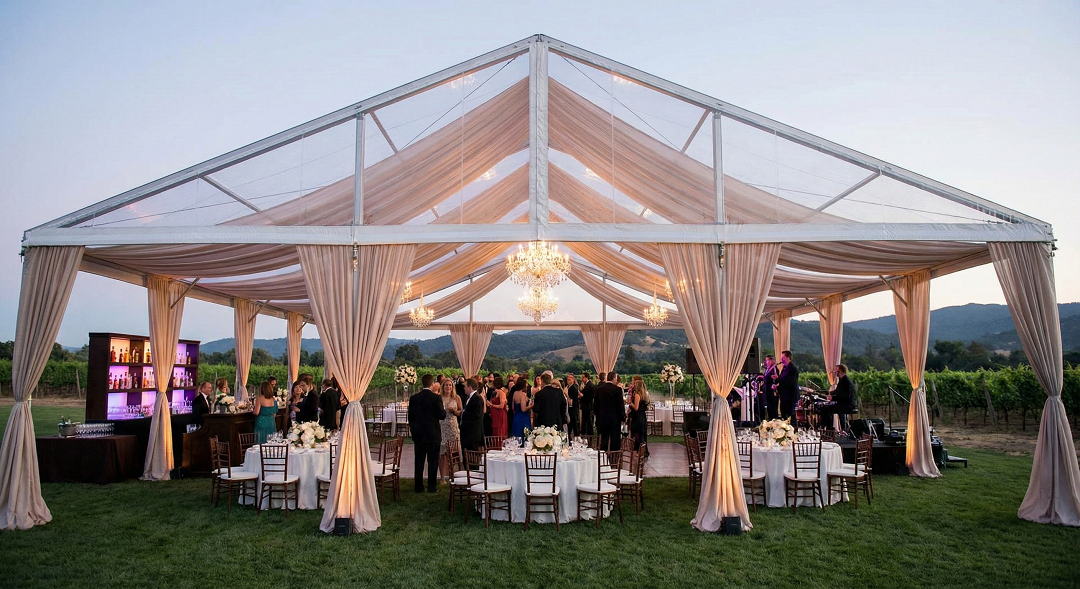
A partnership is judged on what happens after the first container: repeatable quality, scheduled capacity and after-sales support that reaches the site.
A long-term aluminum frame tent partnership is decided by terms that can be written down and checked, not by product descriptions. The relevant set is short: MOQ of 1 unit, a 30–35 day lead time against 90 units of monthly capacity, T/T payment with accommodated terms, FOB, CIF or CFR incoterms, ODM support from design through manufacturing, standardized inspection before shipment, and 24/7 online service with installation and on-site technical support.
Risk control completes the picture. Project-specific anchoring reinforcement, flame-retardant fabric and aluminum profiles designed for local wind and snow loads are the measures that keep a structure serviceable across the 15–20 year service life typically associated with 6061-T6 aluminum frames, and those measures only hold if they are designed per project and inspected on a routine.
For buyers comparing supplier options, the practical next step is to request the company profile and product documentation, then test the framework with a single unit before scaling to a scheduled program.
Next step: download the Shoulder Tent company profile (PDF), or send your project brief for a quotation and sample discussion.
Shenzhen Shoulder Tent Co., Ltd. (Shoulder Tent)
Website: www.shouldertent.com
Email: info@shouldertent.com | Phone / WhatsApp: +86 158 1850 8822
Management Center Shenzhen: No. 4703B, West Tower, Galaxy Twin Towers, Shenzhen, China
Marketing Center Guangzhou: Room 1508, South Tower, Guangzhou World Trade Center Complex, China
Have Questions or Need More Details?
Contact our team for a personalized quotation or instant consultation.
Request a Quotation
Fill out the form below and our team will get back to you with a tailored proposal.
WhatsApp Direct Chat
Prefer to chat in real-time? Message us on WhatsApp for instant assistance & quick answers.
- Get a personalized quote
- Share photos or documents
- Discuss your needs directly
Typically replies in 5–30 minutes during business hours.