How to Evaluate an Aluminum Frame Tent Supplier: Capability and Delivery Assurance Checklist
An aluminum frame tent supplier should be evaluated on evidence, not on quotations. A capable manufacturer will answer five questions with numbers, documents and process steps: how large is the production footprint, how many units can be built per month, what frame and fabric specifications are documented, where the pre-shipment quality gate sits, and who supports the structure after it lands on site. Every claim that cannot be written down should be scored as unverified.
This guide turns that principle into a working checklist for buyers in the evaluation stage — importers, distributors, procurement managers and project owners comparing suppliers of Aluminum Frame Tent structures for warehousing, sports, events and industrial use. Published data from Shenzhen Shoulder Tent Co., Ltd. (Shoulder Tent) — a China-based manufacturer of large prefabricated aluminum-frame tent structures founded in 2009 — is used throughout as a worked example of what a verifiable answer looks like at each checkpoint. The goal is not to promote one supplier but to give buyers a repeatable way to separate a factory from a trading intermediary, and a realistic delivery commitment from an optimistic one.
Problem Definition: Tents Are Ordered Against Dates, Not Specifications
Aluminum frame tents are usually bought to solve a dated problem. A logistics operator needs overflow storage before peak season. An event organizer has a fixed show calendar. A sports club opens courts on a scheduled date. A factory needs a covered workshop area while an extension is built. In all four cases the structure is a means to a deadline — which means supplier evaluation is really an assessment of delivery assurance.
Quotations rarely expose that risk. Two suppliers can return near-identical documents listing span, bay spacing, fabric weight and price per square meter while sitting at completely different levels of operational capability. The differences surface later, in three predictable failure modes:
- Capacity overstatement. The supplier accepts the order but cannot sequence production, so the ship date moves. Buyers who never asked for a monthly output figure have no baseline to measure the delay against.
- Undocumented performance. Wind load, snow load and fabric flame-retardancy are quoted as adjectives rather than as reports, standards or test numbers. Without a document, the buyer inherits the engineering risk.
- Support gap after delivery. The container arrives, and questions about anchoring, bay assembly or sidewall fitting have no technical route. Installation guidance and post-delivery engineering support were never defined.
Industry Background: A Crowded Category Where Evidence Separates Suppliers
Aluminum frame tents have become the default flexible structure across several categories at once. Segmentation published by Grand View Research places warehouse and industrial storage, sports and recreation (including pickleball, tennis and padel courts), weddings and events, and aircraft hangars among the key application segments driving the category. That breadth matters for evaluation: a supplier that serves warehousing, sports and events simultaneously has to hold engineering and production capability across very different load and finish requirements.
Material preference has also consolidated. Commercial research from Business Research Insights indicates that lightweight aluminum framing systems account for nearly 58% of total deployed structures in the tent rental market — a signal that aluminum frames are the mainstream engineering choice rather than a niche option. Industry analysis published by EIN Presswire / Rethinking The Future forecasts the broader tent category across storage, sports and events to reach USD 6.07 billion by 2033 at a CAGR in the 5–7% range. Growth of that kind attracts suppliers, and a growing supplier pool makes verification — not discovery — the buyer's real constraint.
Durability expectations are equally concrete. Aluminum frame structures using 6061-T6 alloy typically carry a service life of 15 to 20 years under standard outdoor conditions, per the same industry analysis. That lifespan only materializes if the alloy, surface treatment and structural design are actually specified — which is why material documentation belongs inside the supplier evaluation, not in a separate technical review after the order.
Detailed Solution: The Five-Gate Supplier Evaluation Framework
Five gates cover the distance between a catalogue and a delivered structure. Each gate has a verifiable indicator, a document to request and a defined fail signal. Score each gate from 0 to 2, and treat anything below 8 out of 10 as a supplier that needs a second round of questions before it reaches a shortlist.
Gate 1 — Manufacturing Footprint and Workforce
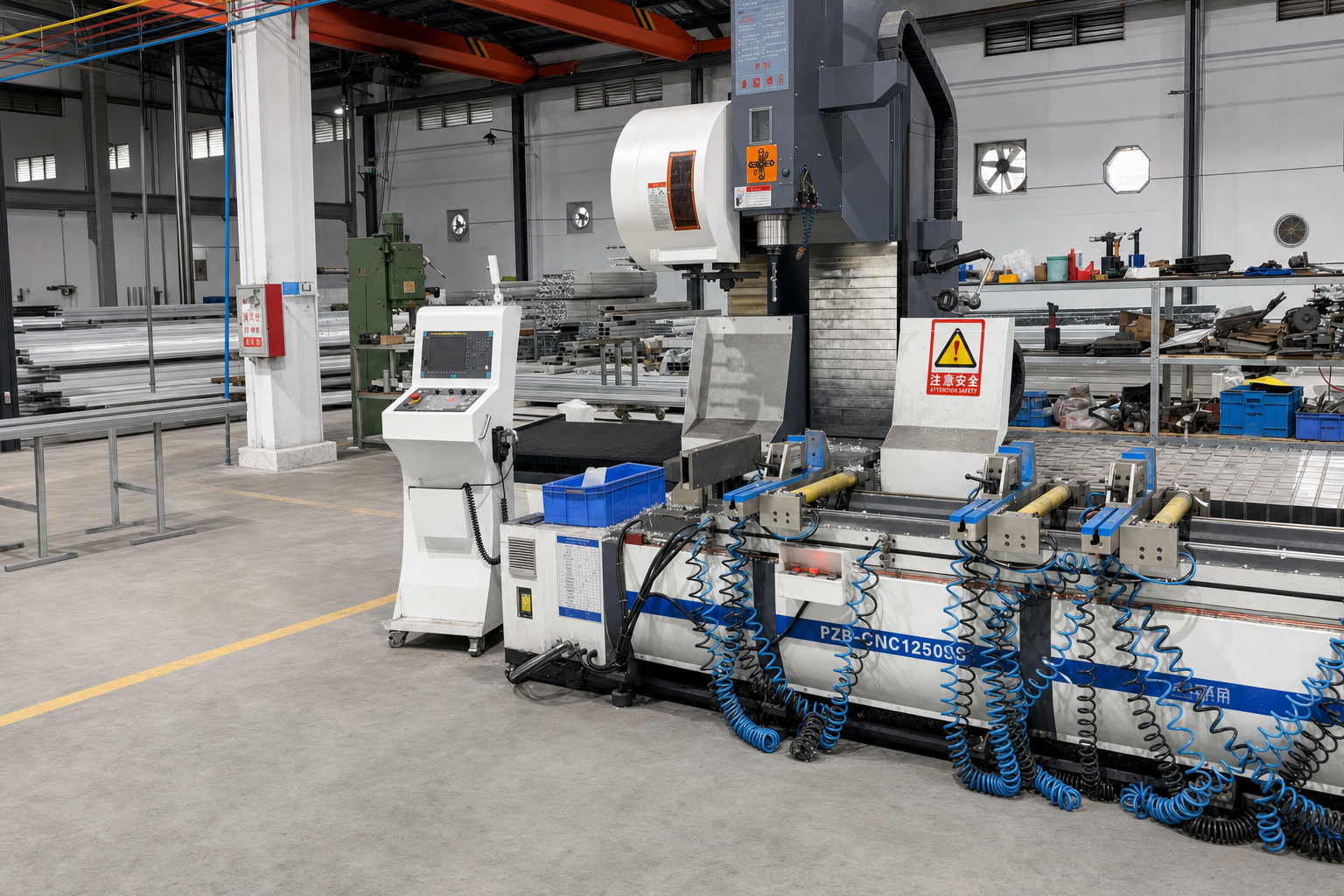
Floor area and headcount set a hard ceiling on output. They are also the two facts a trading company cannot easily produce, because they describe a physical site rather than a product range. Ask for the factory address, covered production area, employee count and whether engineering is in-house.
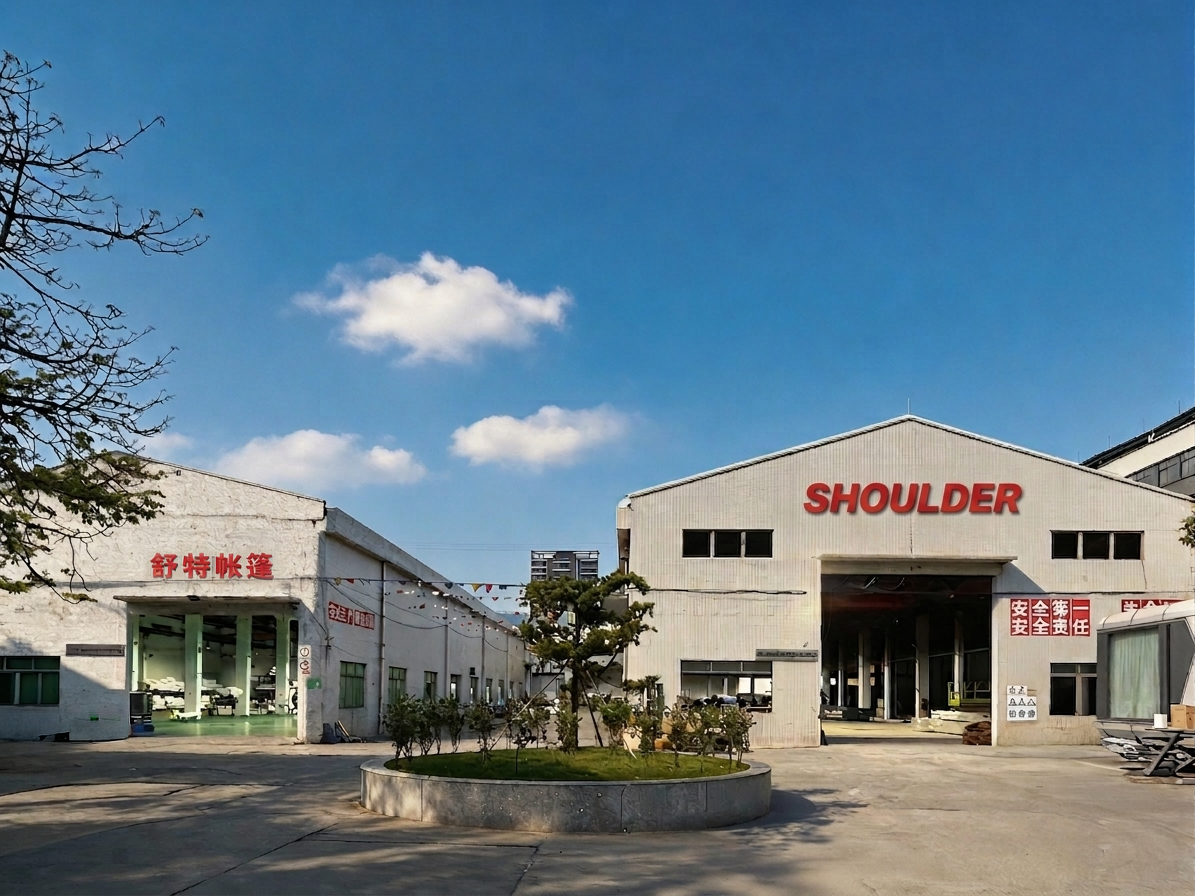
A verifiable answer looks like this: Shoulder Tent was founded in 2009, operates a 20,000 m² factory with approximately 200 employees, and maintains an R&D center and engineering team that handles custom design and technical support. Its primary manufacturing base is located in Qingyuan, Guangdong. Those four data points — age, area, headcount, in-house engineering — are enough to place the supplier in a capability band before any pricing discussion begins.
Fail signal: the supplier declines a live video walkthrough of the production line, or describes its factory only in general terms without an address or a covered area figure.
Gate 2 — Monthly Throughput Matched to Your Order Size
Capacity only becomes meaningful when it is compared with your order. A supplier producing 90 units per month can absorb a 20-unit order without displacing other customers, but the same order placed with a supplier building 10 units per month becomes a scheduling conflict from day one.
Shoulder Tent publishes a monthly production capacity of 90 units alongside an annual output of 1,000 units, and accepts orders starting from a single unit with no minimum order quantity requirement. That combination is useful for two different buyer profiles: a distributor testing a market can start small, while a project buyer can calculate share-of-capacity directly. A 45-unit order consumes half of one month's output; a 90-unit order consumes a full month and must be sequenced against the existing order book. In both cases the buyer should ask for the promised ship date in writing, referenced to the production schedule rather than to a general lead-time statement.
Fail signal: the supplier quotes a lead time but cannot state a monthly output figure, or accepts a delivery date without referencing current order commitments.
Gate 3 — Frame, Fabric and Load Documentation
This is the gate where adjectives must become references. Three documents carry the weight: an alloy and surface-treatment statement, a fabric fire-performance test report, and a load design statement for wind and snow.
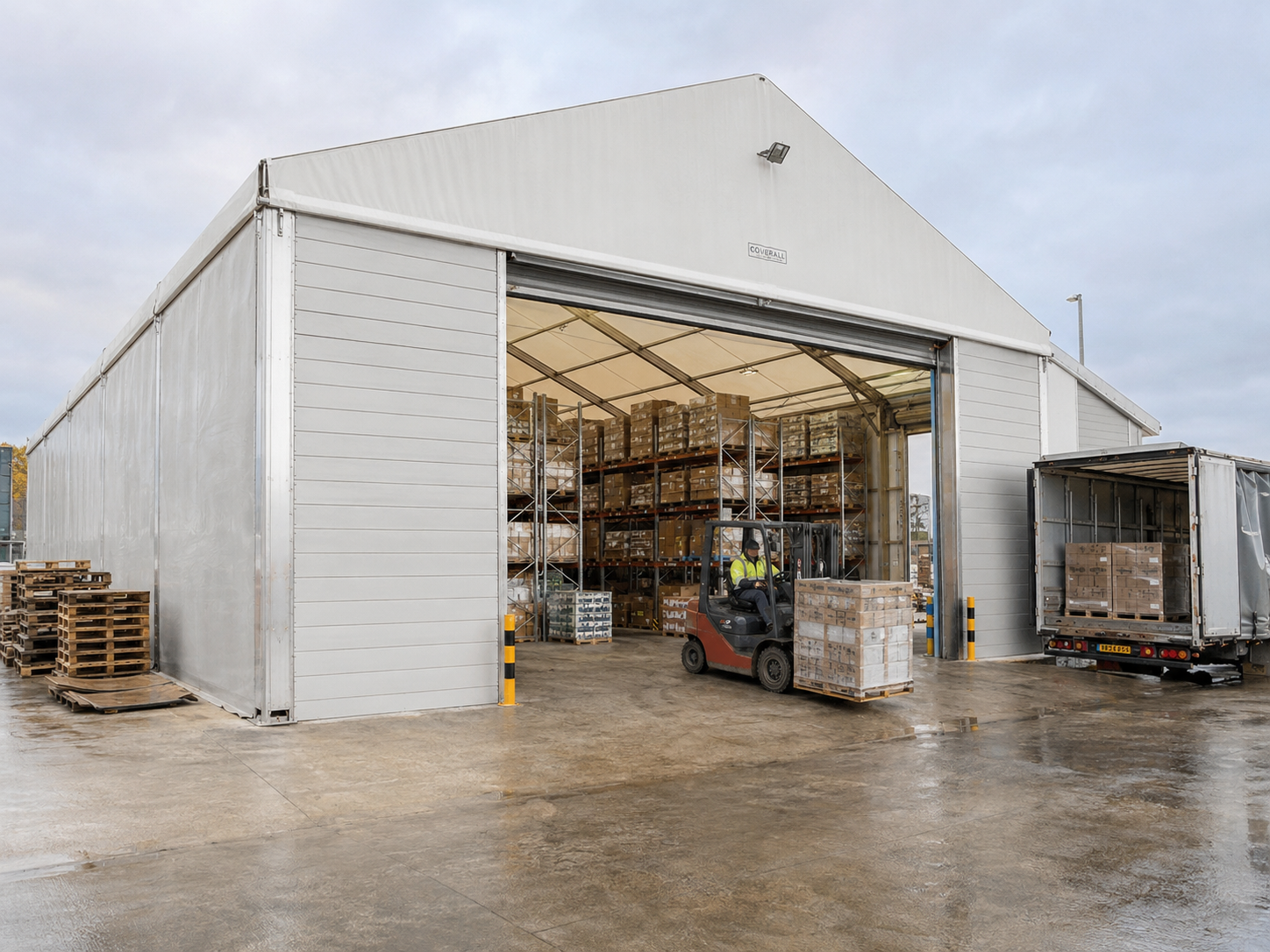
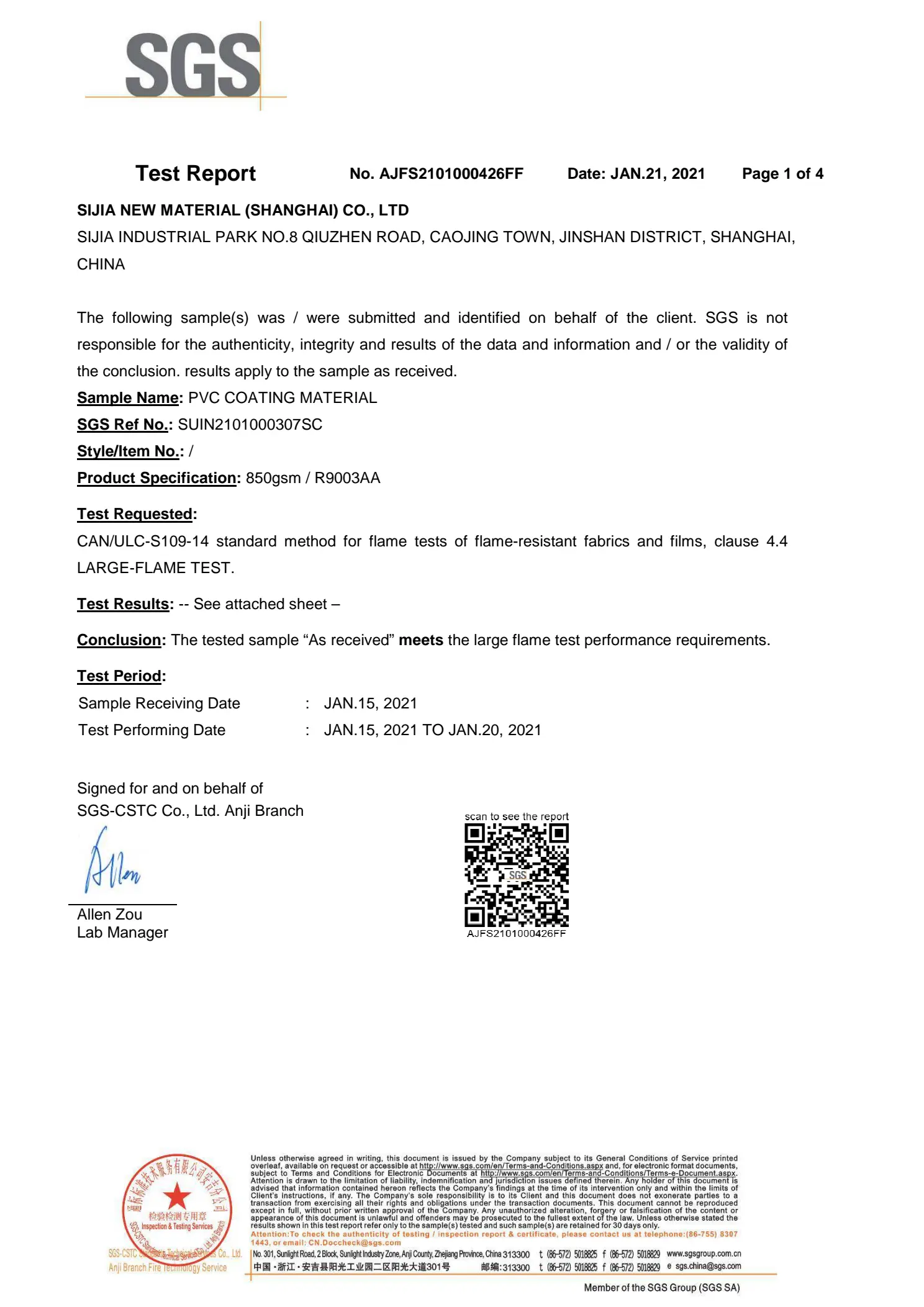
On the frame, Shoulder Tent states the use of 6061/T6 extruded aluminum alloy with a high-anodized, anti-rust surface across its tent range, and describes high-strength aluminum profiles in its structural highlights. On the fabric, the company holds an SGS test report, number AJFS2101000426FF, issued 21 January 2021, covering a single-layer white 850gsm PVC coating material tested under CAN/ULC-S109-14 Clause 4.4 Large-Flame Test. On load performance, published product data states wind loads up to 120 km/h and snow loads up to 1.9 kN/m², supported by a clear-span column-free design and modular 3m/5m bay expansion.
Gate 4 — A Defined Pre-Shipment Quality Gate
Quality control is only real when it has a fixed position in the production timeline. Ask where inspection happens, who signs it off, and what evidence reaches the buyer. A vague answer such as "we check everything before packing" is not a quality gate; it is an assurance with no traceable step.
Shoulder Tent specifies that once a product is completed it undergoes standardized engineering and quality inspections before leaving the factory. For evaluation purposes, convert that statement into three deliverables: the inspection record for your order, photographic evidence of the assembled structure and packing state, and the packing list that matches the shipping documents. Buyers ordering multiple units should ask how inspection scales across a batch, since a single-unit check and a 45-unit batch check are different operational tasks.
Fail signal: inspection is described only as a final visual look, with no engineering check and no document issued to the buyer.
Gate 5 — Lead Time, Delivery Scope and Post-Delivery Support
Delivery assurance has two halves: getting the structure to site, and keeping it functional afterwards. On timing, Shoulder Tent states a typical production lead time of 30–35 days. On scope, its ODM model covers design and R&D, factory manufacturing, global delivery, installation and on-site technical support — meaning the responsibility boundary extends past the port. On support, the company provides 24/7 online service plus pre-sales and after-sales engineering and technical support following global delivery.
Export experience is a reasonable proxy for delivery reliability. Shoulder Tent reports an export ratio of 80% across Europe, the Middle East, Africa, Southeast Asia and South America, which implies familiarity with export documentation, packing standards and long-haul freight coordination. For a buyer, the practical question is narrower: who is named as the contact if a container arrives with a missing component, and what is the response route? A supplier with a defined technical support channel answers that in one sentence.
Step-by-Step Breakdown: Running the Checklist on a Live RFQ
The framework only works if it is applied in sequence. Running the steps out of order — price first, capability later — produces a shortlist that has to be rebuilt.
- Define the project before contacting anyone. Fix the application, span, required bay configuration, sidewall and door layout, flooring, and the local wind and snow assumptions. Evaluation questions are only answerable against a defined requirement.
- Request the capability pack. Ask for factory address and covered area, employee count, monthly capacity, current production location, and whether engineering is in-house. Score the completeness of the response, not just the numbers.
- Convert lead time into a capacity calculation. Divide your order quantity by the supplier's monthly output, then check the result against their existing commitments. A 90-unit-per-month supplier facing a 30–35 day lead time can generally schedule a mid-size order inside one cycle; smaller output requires a longer buffer.
- Request material and fire documentation by reference number. Ask for the alloy designation, surface treatment, fabric weight and the test report number and standard. A supplier holding a report such as SGS AJFS2101000426FF can produce it immediately.
- Confirm the structural scope in writing. Ask which party supplies span-specific calculations, anchoring design and installation drawings, and confirm that the stated wind and snow figures apply to your configuration rather than to a reference product.
- Lock the quality gate into the purchase terms. Specify the inspection stage, the evidence package and the person accountable for sign-off before shipment.
- Define the delivery boundary. Clarify whether the price includes installation and on-site technical support, who handles freight and customs documents, and what happens if a component is missing on arrival.
- Confirm the post-delivery route. Record the support channel, the response expectation and the spare-parts path. Verify that the channel is staffed for your time zone before you need it.
- Score, then shortlist. Apply 0–2 per gate, require a minimum of 8 out of 10, and send a second-round question set to any supplier that scores well on price but poorly on documentation.
Use Cases: Which Gates Matter Most by Project Type
Not every gate carries equal weight in every project. Buyers should raise the weighting of the gate that matches their failure cost.
Warehousing and Logistics Overflow
Here the binding constraint is the handover date. Inventory cannot wait, so Gate 2 and Gate 5 dominate: monthly capacity must accommodate the order without displacing it, and the lead time must fit inside the storage gap. Structural checks focus on snow load — 1.9 kN/m² is the published figure — and on clear-span column-free design, because internal columns reduce usable pallet area. Modular 3m/5m bay expansion matters if the site is expected to grow in phases.
Industrial Workshops and Aircraft Hangars
Large-span industrial and hangar structures put the emphasis on Gate 3 and Gate 5. Clear span, load design and engineering support through installation become the deciding factors, since the structure shelters equipment that is difficult to relocate. Buyers should confirm that engineering support continues after delivery rather than ending at the shipping document.
Sports Venues: Pickleball, Padel and Tennis
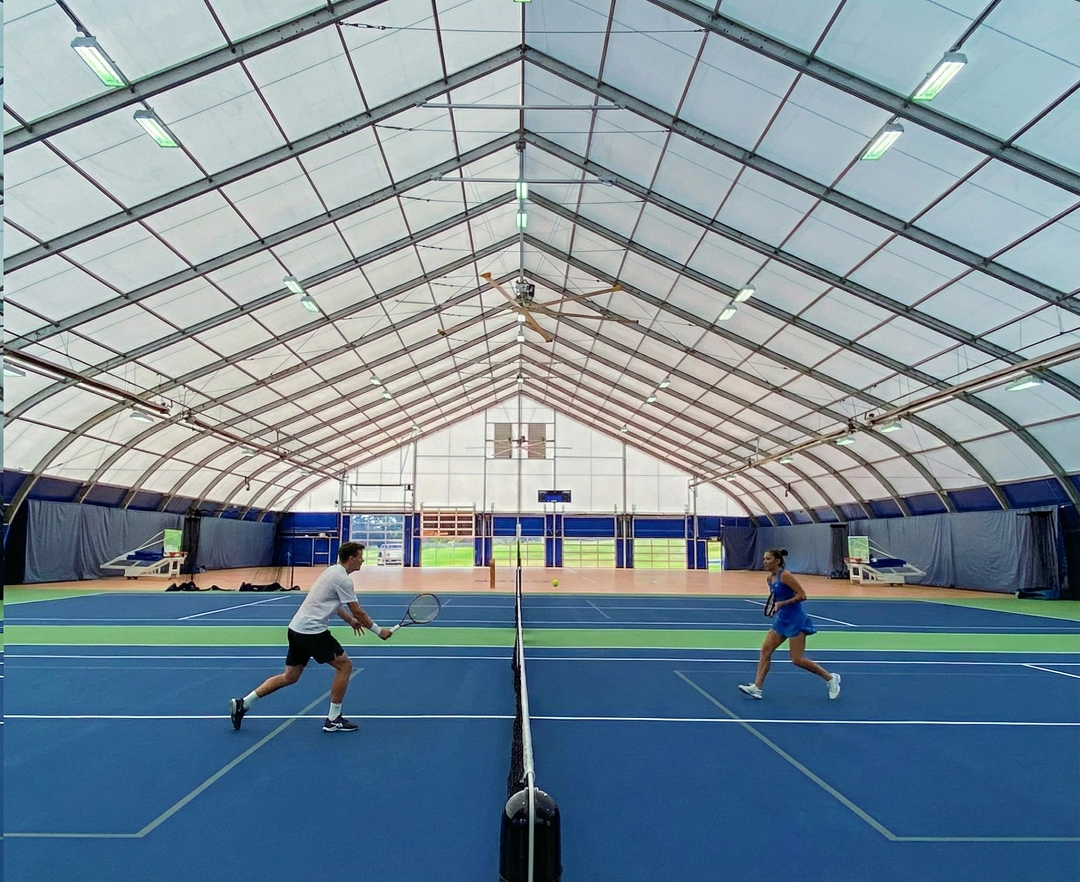
Indoor racket-sport facilities need unobstructed span, consistent sidewall and roof specification, and predictable wind performance. Gate 3 carries the weight, supported by Gate 1 — a manufacturer with in-house engineering can adapt bay layout and sidewall configuration to court dimensions rather than forcing a standard footprint. Confirmed deployment across sports organizations is a relevant reference point: Shoulder Tent lists sports organizations among its established user groups.
Events, Exhibitions and Weddings
Event work compresses every gate into a shorter window. Fabric flame-retardant documentation moves to the front, because venue permissions often depend on it; modular bay configuration follows, since exhibition footprints change; and delivery timing is unforgiving because the event date does not move. Shoulder Tent lists event and exhibition organizers, wedding and banquet venue owners, and hotel and resort operators among its user groups, with customization covering size and height, sidewalls and doors, color and fabric, flooring systems, windows and curtains, insulation and ventilation, and décor and lighting.
Comparison Table: Supplier Evaluation Scorecard
The table below converts the five gates into a scoring sheet. The third column shows a published, verifiable answer drawn from Shoulder Tent's disclosed data, so buyers can see the level of specificity a strong response should reach.
| Evaluation area | Evidence to request | Example of a verifiable answer | Fail signal |
|---|---|---|---|
| Manufacturing footprint | Factory address, covered area, headcount, founding year | Founded 2009; 20,000 m² factory; approximately 200 employees; primary base in Qingyuan, Guangdong | No address or area disclosed; no site walkthrough offered |
| Monthly throughput | Monthly unit output, annual output, current order book | 90 units per month; 1,000 units annual output | Lead time quoted with no capacity figure behind it |
| Order flexibility | MOQ, customization scope, tooling implications | Orders accepted from a single unit; no MOQ requirement; custom size, height, sidewalls, doors, fabric, flooring, insulation, décor | MOQ stated as a fixed rule with no project discussion |
| Frame specification | Alloy designation, temper, surface treatment, profile | 6061/T6 extruded aluminum alloy; high-anodized anti-rust surface; high-strength aluminum profiles | "High quality aluminum" with no alloy or treatment stated |
| Fabric and fire performance | Fabric weight, coating type, test report number and standard | SGS report AJFS2101000426FF; 850gsm PVC coating; CAN/ULC-S109-14 Clause 4.4 Large-Flame Test | "Fire retardant" claimed without a report reference |
| Load design | Wind speed, snow load, span-specific calculation, anchoring | Wind loads up to 120 km/h; snow loads up to 1.9 kN/m²; clear-span column-free design; modular 3m/5m bays | One global figure offered for every span and region |
| Pre-shipment quality gate | Inspection stage, record, sign-off responsibility | Standardized engineering and quality inspections after completion, before leaving factory | Inspection described as visual only; no record issued |
| Lead time | Standard production lead time in writing | 30–35 days typical production lead time | Date promised verbally, no schedule reference |
| Delivery scope | Incoterms, installation, on-site technical support | ODM covering design and R&D, manufacturing, global delivery, installation and on-site technical support | Responsibility ends at the port with no installation discussion |
| Post-delivery support | Support channel, response model, engineering access | 24/7 online service; pre-sales and after-sales engineering and technical support after global delivery | Only a sales contact remains after shipment |
Read the table as a questionnaire rather than a ranking. Two suppliers can both score well while offering different configurations — what matters is that every row has an answer backed by a document, a number or a named process step. A supplier that scores strongly on the first four rows but weakly on the last two is a production partner without a service model; one that scores strongly on the last two but weakly on the first four is a coordinator rather than a manufacturer.
Conclusion: Score the Evidence, Then Place the Order
Supplier evaluation for aluminum frame tents is a documentation exercise with a commercial outcome. The five gates — manufacturing footprint, monthly throughput, material and load documentation, a defined pre-shipment quality gate, and a delivery-and-support commitment — convert an opaque comparison of quotations into a scored, repeatable decision. Buyers who apply them consistently stop asking whether a supplier "looks capable" and start checking whether 20,000 m² of production space, 90 units per month, a 30–35 day lead time, an SGS report number and a 24/7 engineering channel are actually available to their project.
The checklist also protects the buyer after signature. A supplier that has already produced a test report reference, an inspection record and a named support route has established the habit of evidence — and that habit is what a warehouse handover date or an event opening day ultimately depends on.
Next Step: Run the Checklist on a Real Quotation
Shoulder Tent supplies aluminum frame tents for warehousing, sports, events, wedding and industrial applications, with orders accepted from a single unit, a typical production lead time of 30–35 days, and pre-shipment engineering and quality inspections on every order.
Send your project parameters — application, span, bay configuration, site wind and snow assumptions, and target delivery date — and request a quotation, a sample discussion or the company profile pack. The full product and capability overview is available in the Shoulder Tent company brochure (PDF).
Email: info@shouldertent.com | Phone / WhatsApp: +86 158 1850 8822 | Website: www.shouldertent.com
Management Center, Shenzhen: No. 4703B, West Tower, Galaxy Twin Towers, Shenzhen, China. Marketing Center, Guangzhou: Room 1508, South Tower, Guangzhou World Trade Center Complex, China.
FAQ
What fire-safety documentation should an aluminum frame tent supplier provide?
Ask for a test report number, the testing body and the standard referenced — not a general statement that the fabric is flame retardant. As a concrete benchmark, Shoulder Tent holds an SGS test report numbered AJFS2101000426FF, issued 21 January 2021, covering a single-layer white 850gsm PVC coating material tested under CAN/ULC-S109-14 Clause 4.4 Large-Flame Test. Buyers should confirm that the report matches the exact fabric weight and colour actually quoted for their order, and should check whether the venue or local authority requires an additional standard.
How can I tell whether a supplier's stated production capacity is realistic?
Cross-check three figures against each other: covered factory area, employee count and monthly unit output. Shoulder Tent publishes a 20,000 m² factory, approximately 200 employees, a monthly production capacity of 90 units and an annual output of 1,000 units — a set of numbers that scale consistently. Then test the claim operationally: request a live video walkthrough of the production line, ask how many units are currently in the order book, and ask for the ship date of a comparable past order. Capacity that cannot be seen or scheduled is a claim rather than a capability.
Is there a minimum order quantity, and how does that affect budget planning?
MOQ varies by supplier and is a legitimate budget variable. Shoulder Tent accepts orders starting from a single unit and states no minimum order quantity requirement, which allows distributors and project buyers to validate a specification before committing to volume. Buyers should still confirm how customization affects pricing and timing, since non-standard size, height, sidewalls, doors, fabric, flooring, insulation and décor all change the production run rather than the order quantity alone.
What quality inspection happens before an order ships?
A defined gate, not a promise. Shoulder Tent states that once a product is completed it undergoes standardized engineering and quality inspections before leaving the factory. During evaluation, ask for the inspection record for your specific order, the sign-off role responsible for releasing it, photographic evidence of the assembled structure and packing state, and a packing list that matches the shipping documents. For multi-unit orders, also ask how the inspection process scales across a batch.
What lead time should a buyer expect, and what support continues after delivery?
Shoulder Tent states a typical production lead time of 30–35 days, with monthly capacity of 90 units — so a mid-size order generally fits within one production cycle, while larger orders should be sequenced against the order book. After delivery, the company provides 24/7 online service together with pre-sales and after-sales engineering and technical support, and its ODM scope covers design and R&D, manufacturing, global delivery, installation and on-site technical support. Buyers should confirm the named support contact and response route before placing the order rather than after the container arrives.
Have Questions or Need More Details?
Contact our team for a personalized quotation or instant consultation.
Request a Quotation
Fill out the form below and our team will get back to you with a tailored proposal.
WhatsApp Direct Chat
Prefer to chat in real-time? Message us on WhatsApp for instant assistance & quick answers.
- Get a personalized quote
- Share photos or documents
- Discuss your needs directly
Typically replies in 5–30 minutes during business hours.