Temporary Warehouse Overflow? How Aluminum Frame Tents Solve It
When seasonal inventory, delayed inbound shipments, or event equipment outgrow permanent warehouse space, an aluminum frame tent can add covered storage without waiting for a fixed building. The format uses a clear-span, column-free design, modular 3m/5m bay expansion, high-strength aluminum profiles, and double PVC waterproof/flame-retardant fabric. Shoulder Tent lists wind loads in the 100–120 km/h range and snow loads up to 1.9 kN/m² for its aluminum frame tent range.
The decision is not simply “tent or warehouse.” It is a capacity question: how much covered space is needed, for how long, with what access, and under which local compliance requirements. A temporary warehouse tent is most useful when the answer requires speed, modular scale, and a structure that can be specified around storage operations rather than around a fixed construction programme.
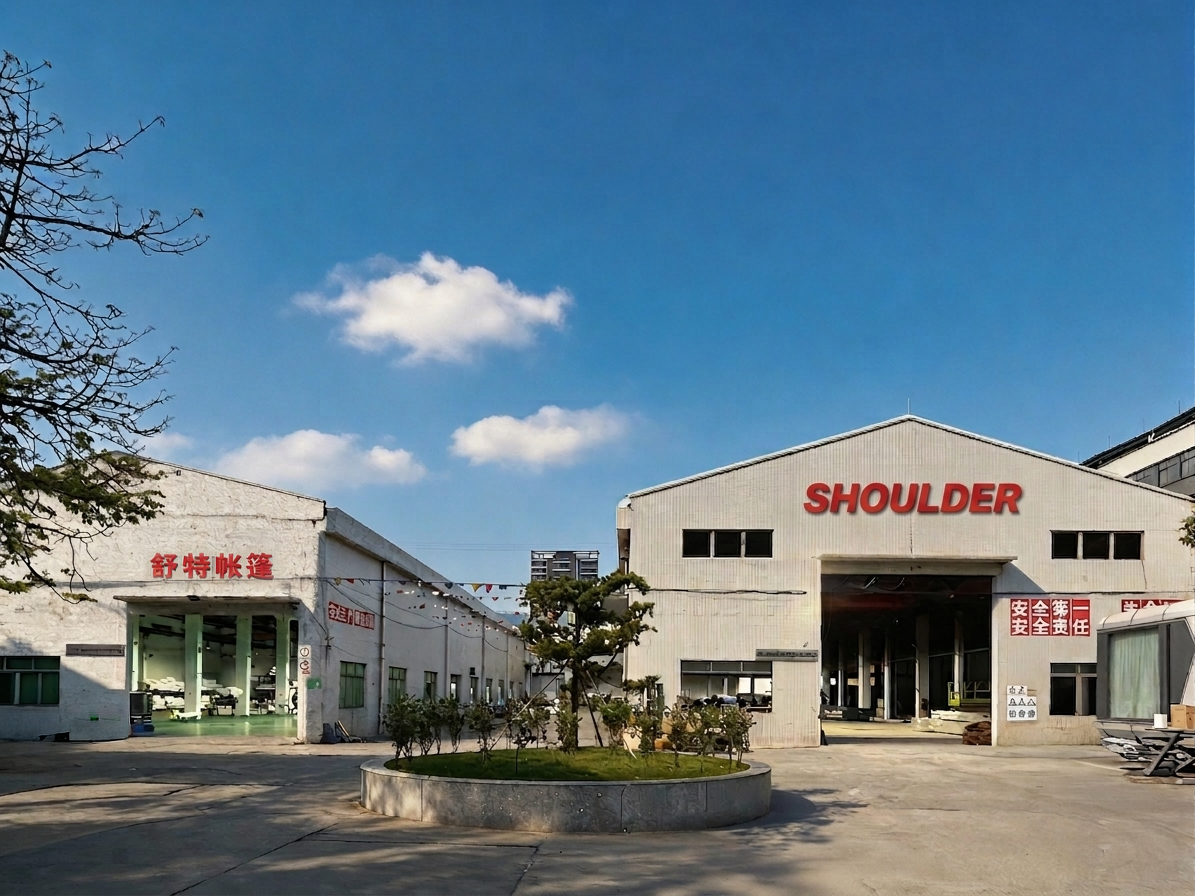
Shenzhen Shoulder Tent Co., Ltd. (Shoulder Tent) is a China-based manufacturer of large prefabricated aluminum-frame tent structures, founded in 2009. The company operates a 20,000 m² factory, reports an annual output of 1,000 units, and lists warehouse, sports, wedding, event, exhibition, and commercial applications across its product range. Its aluminum frame tent range includes models S30-1, S32, S45-1, S45-2, and S60-1.
Problem Definition: What Warehouse Overflow Actually Disrupts
Warehouse overflow is rarely just a space problem. It affects receiving, picking, inventory accuracy, and the ability to keep temporary stock protected from weather and contamination. For logistics and warehousing companies, the pressure often appears as seasonal SKU peaks, delayed outbound shipments, or a short-term contract that adds pallets faster than permanent racking can absorb them.
Event organizers face a related pain point: back-of-house equipment, furniture, staging, audio-visual gear, and temporary inventory need covered space close to the venue but outside the main event footprint. Industrial manufacturers may need temporary storage for raw materials, finished goods, or workshop overflow. In each case, the buyer needs a covered structure that can be specified quickly, expanded in stages, and documented for site conditions.
- Fixed capacity: permanent warehouse space cannot be scaled up for a short peak without long construction or lease commitments.
- Internal columns: conventional buildings can interrupt pallet flow, racking layouts, and vehicle movement.
- Weather exposure: temporary outdoor storage needs waterproof covering, flame-retardant fabric, and wind/snow performance suitable for the site.
- Compliance uncertainty: buyers need material documentation, anchorage planning, and project-specific wind and snow verification.
- Speed: overflow often has to be solved before the next inbound container or event build-up, not after a fixed construction schedule.
An aluminum frame tent addresses these pain points by turning a covered structure into a configurable storage asset. The buyer can define the footprint, sidewalls, doors, flooring, and accessories, then confirm the structural and commercial details before production.
Industry Background: Why Aluminum Frame Tents Are Now a Mainstream Storage Solution
Aluminum frame tents are no longer limited to short-event use. The verified data set for this category notes that lightweight aluminum framing systems account for nearly 58% of total deployed structures in the tent rental market. That adoption reflects the practical advantages of aluminum frames: they are lighter to handle than steel alternatives, resist corrosion, and support modular clear-span designs.
The same data set notes that aluminum frame structures made of 6061-T6 alloy typically have a service life of 15 to 20 years. For buyers evaluating temporary or semi-permanent warehouse overflow, that service-life range matters because it moves the decision beyond a one-season purchase. The broader tent category, including storage, sports, and events, is forecast to reach USD 6.07 billion by 2033 at a CAGR of 5–7%, which signals continued demand for flexible covered structures rather than only permanent construction.
Shoulder Tent’s product portfolio reflects that wider use. The company lists A-Shape, Arc/Curved, APS hybrid, Dome/geodesic, Mixed/polygon/high-peak, Pagoda/Gazebo, and warehouse, sports, wedding, and event solutions. For warehouse overflow projects, the relevant configuration is usually a clear-span aluminum frame tent with sidewalls, doors, and a PVC cover that can be specified around storage access and site conditions.
Detailed Solution: How an Aluminum Frame Tent Solves Warehouse Overflow
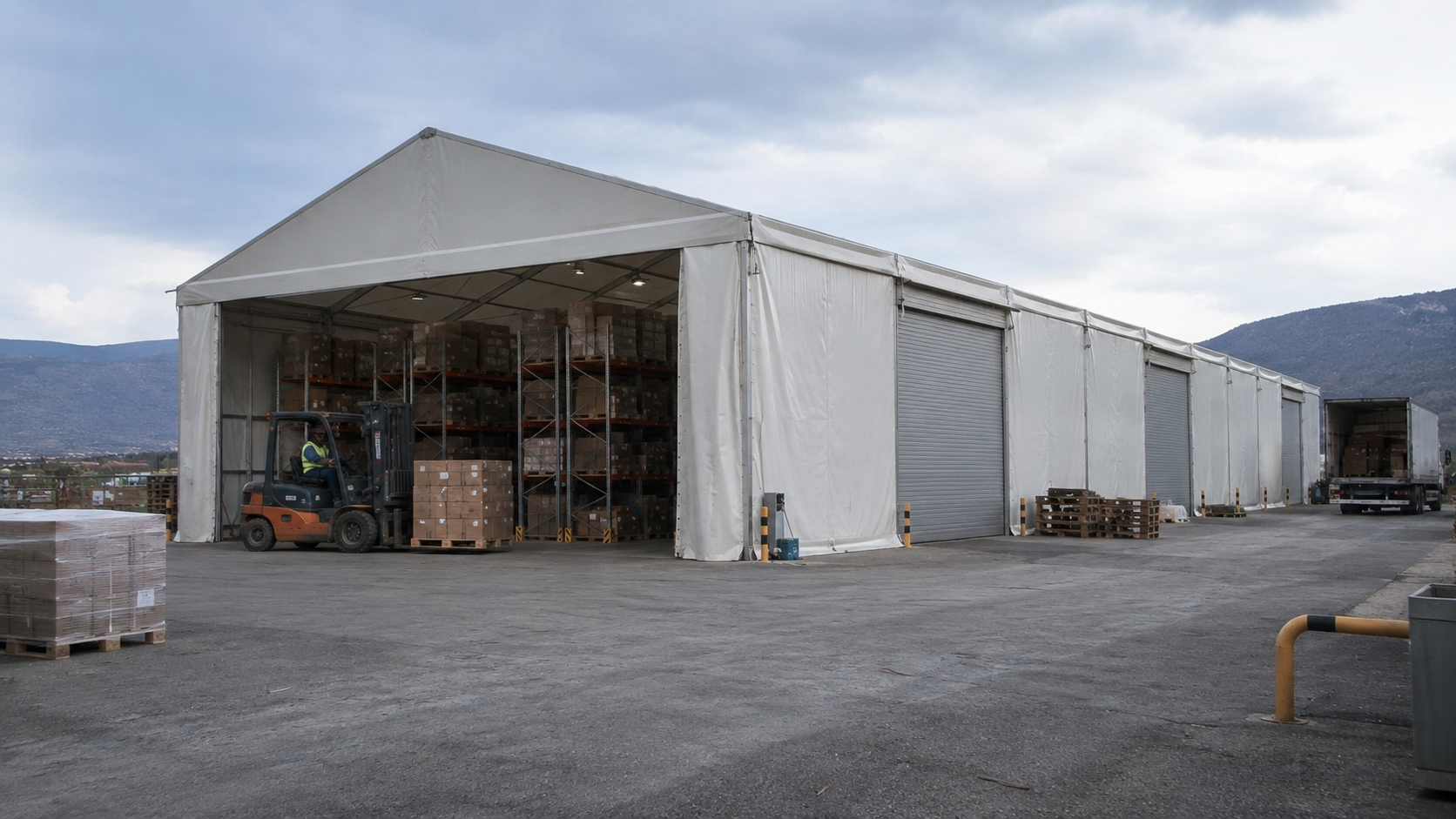
An aluminum frame tent solves warehouse overflow by creating a covered, clear-span storage area that can be expanded in modular bays and specified with warehouse-relevant accessories. The structure is not a single fixed product; it is a configuration built from a frame, cover, sidewalls, doors, flooring, and optional environmental controls.
Clear-span, column-free layout
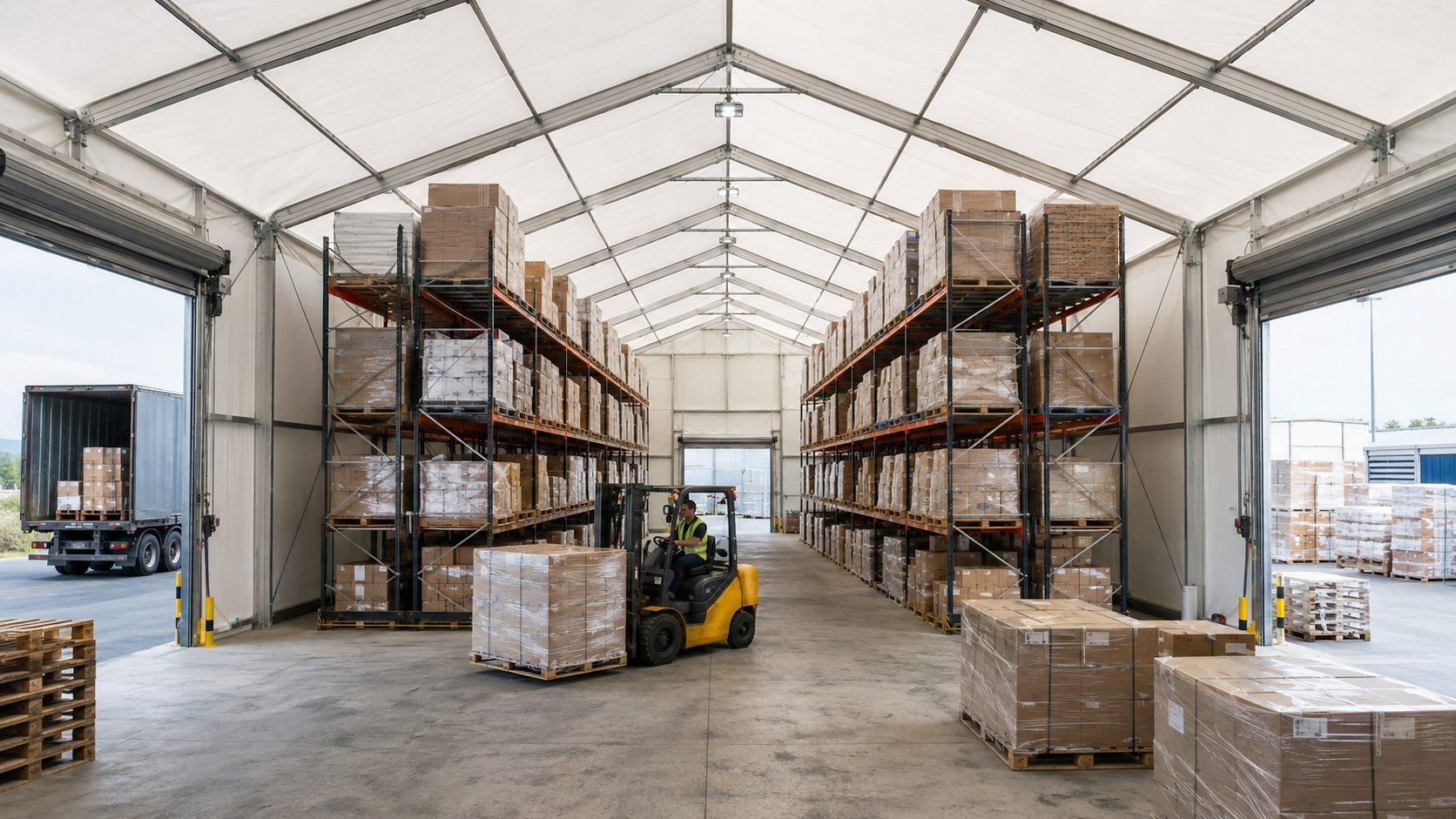
The clear-span, column-free design removes internal support columns from the usable storage area. That matters for pallet racking, forklift movement, temporary receiving lanes, and event back-of-house equipment storage. A column-free interior allows the buyer to plan storage density around operations rather than around structural obstructions.
Modular 3m/5m bay expansion
Shoulder Tent’s aluminum frame tents support modular 3m/5m bay expansion. This lets a buyer start with a defined overflow footprint and add bays in stages as inventory volume changes. Modular expansion is useful for logistics companies that need to phase capacity, and for event organizers who need temporary back-of-house space for a specific build-up and dismantling cycle.
High-strength aluminum profiles
The frame uses high-strength aluminum profiles. In practice, the frame material affects handling, corrosion resistance, and the ability to maintain a clear-span structure. Buyers should still request project-specific structural documentation for the intended span, wind exposure, snow load, and anchorage method.
Double PVC waterproof and flame-retardant fabric
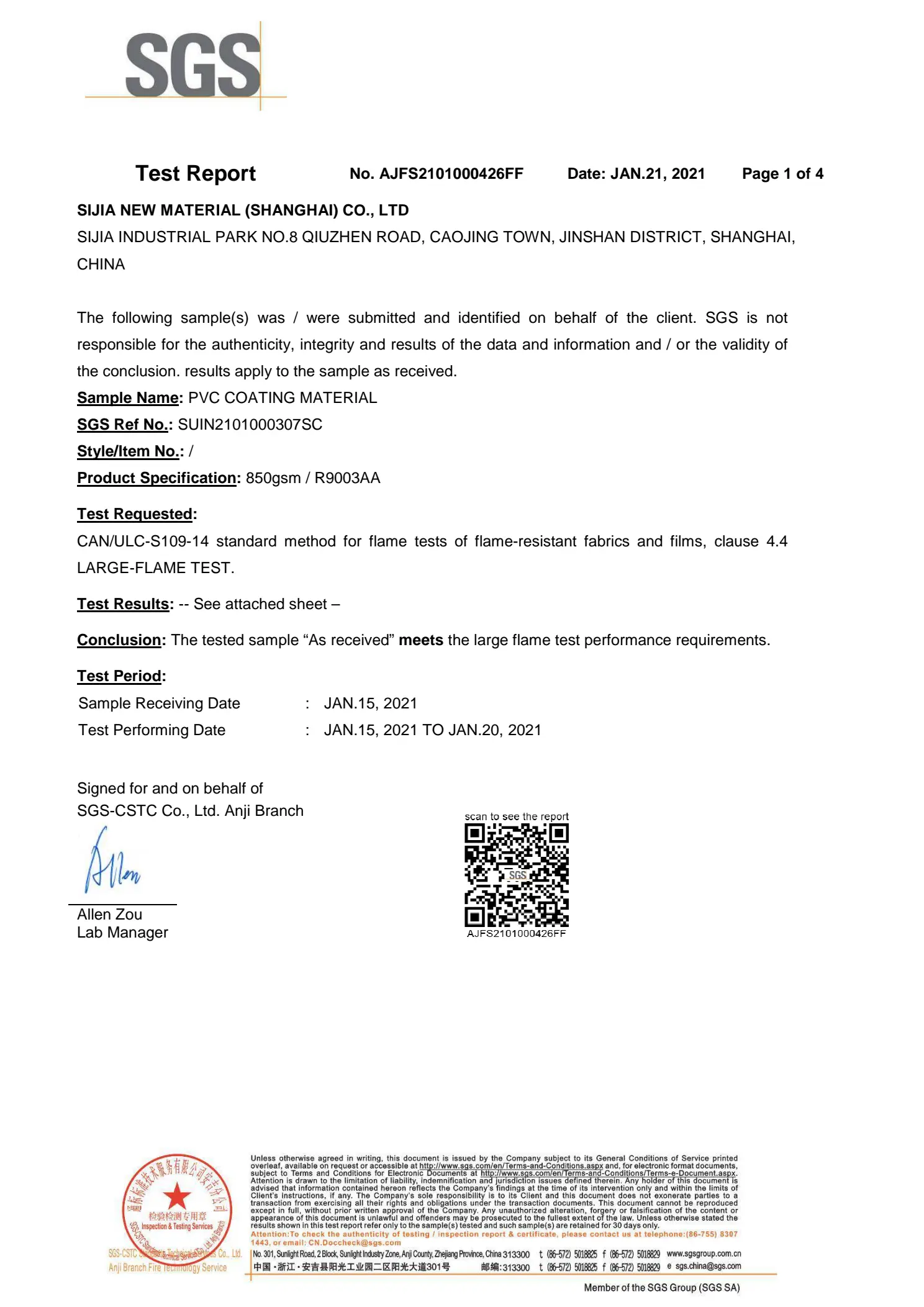
The cover uses double PVC waterproof/flame-retardant fabric, described in the product data as double-layer PVC-coated polyester tarpaulin. For warehouse overflow, the cover has to protect inventory from rain and moisture while meeting the fire-safety expectations of the site. Shoulder Tent provides an SGS Test Report for 850gsm PVC Coating Material under certificate AJFS2101000426FF. The report references CAN/ULC-S109-14 Clause 4.4 Large-Flame Test and covers single-layer white PVC coating material.
Wind and snow performance
Shoulder Tent lists a maximum wind load of 100–120 km/h and a snow load of up to 1.9 kN/m² for its aluminum frame tent range. These are product-level figures, not a substitute for site-specific engineering. Buyers in high-wind or heavy-snow regions should confirm the design basis, anchorage, exposure category, and local permitting requirements before ordering.
Accessories that turn a shell into a working warehouse
A warehouse tent becomes operational when it includes the right access and environmental details. Shoulder Tent’s customization options include size and height, sidewalls and doors, color and fabric, flooring systems, windows and curtains, insulation and ventilation options, and décor and lighting. For storage use, sidewalls and doors are typically the first specifications to confirm because they determine how pallets, equipment, and vehicles enter and leave the structure.
ODM support and quality control
Shoulder Tent provides ODM production services including design and R&D, factory manufacturing, global delivery, installation, and on-site technical support. Once production is completed, the tent undergoes standardized engineering and quality inspections before leaving the factory. The company also provides 24/7 online service and pre-sales/after-sales engineering and technical support after global delivery.
Commercial terms for pilot and scale-up
Orders are accepted starting from a single unit, with no minimum order quantity requirement. Shoulder Tent lists a 30–35 day lead time and a monthly capacity of 90 units. These terms allow a buyer to test a single overflow unit before expanding into a larger multi-bay temporary warehouse configuration.
The practical value of these capabilities is not simply that a tent can be supplied. It is that the buyer can move from a storage problem to a specified, documented, and expandable structure without committing to a fixed building programme.
Step-by-Step Breakdown: Specifying a Temporary Warehouse Tent
1. Map the overflow volume and site
Start with the pallet count, storage duration, access frequency, and site dimensions. Confirm whether the tent will sit on existing hardstanding, compacted ground, or another surface, and identify how forklifts or delivery vehicles will approach the doors. The site plan should also note wind exposure and any snow-load requirement.
2. Choose the span and bay module
Select a clear-span width that supports the intended storage layout, then plan expansion using the modular 3m/5m bay system. A clear-span, column-free interior is especially useful when racking or vehicle movement cannot work around internal columns.
3. Specify cover, sidewalls, doors, and flooring
Define whether the structure needs full sidewalls, a combination of sidewalls and doors, or open access on one side. Flooring systems, windows, curtains, insulation, ventilation, and lighting can be added according to the storage operation. The cover should be specified as double PVC waterproof/flame-retardant fabric for weather protection.
4. Confirm wind, snow, and anchorage requirements
Use the product data as a starting point: wind loads in the 100–120 km/h range and snow loads up to 1.9 kN/m². Then ask for project-specific confirmation of the anchorage method and structural design for the site. Local permitting and temporary-structure rules should be checked before installation.
5. Review material and fire-safety documentation
Request the relevant material documentation for the cover. Shoulder Tent’s SGS Test Report for 850gsm PVC Coating Material, certificate AJFS2101000426FF, references CAN/ULC-S109-14 Clause 4.4 Large-Flame Test. Buyers should confirm that the report scope matches the specified fabric and project requirement.
6. Confirm commercial terms and production slot
Orders can start from one unit. Shoulder Tent lists a 30–35 day lead time and a 90-unit monthly capacity. Payment methods include T/T, and the company supports FOB, CIF, and CFR trade terms. Specific shipping methods and Incoterms should be confirmed with sales.
7. Plan delivery, installation, and technical support
Shoulder Tent provides global delivery, installation, and on-site technical support as part of its ODM production services. Before shipment, the tent undergoes standardized engineering and quality inspections. After delivery, the company provides 24/7 online service and pre-sales/after-sales engineering and technical support.
Use Cases: Where Temporary Warehouse Tents Fit Best
Logistics and warehousing companies
A logistics operator can use a temporary warehouse tent for seasonal inventory overflow, temporary receiving space, or short-term contract storage. The clear-span interior supports pallet storage and vehicle access, while modular bay expansion allows capacity to be added without committing to a permanent building.
Event organizers and exhibition teams
Event back-of-house storage is a natural fit for aluminum frame tents. Organizers can keep furniture, staging, audio-visual equipment, and event inventory under cover while maintaining a separate service area. Sidewalls, doors, and flooring systems help define a clean and secure back-of-house zone.
Industrial manufacturing and workshop overflow
Manufacturers can use the structure for temporary raw-material storage, finished-goods overflow, or workshop space. The clear-span design supports flexible layouts, and the aluminum frame can be specified with sidewalls, doors, ventilation, and lighting to match the operation.
Agricultural storage and other covered storage
Shoulder Tent lists agricultural storage among the applicable industries for its aluminum frame tents. The same modular approach can be applied where a buyer needs covered storage for equipment, materials, or seasonal goods, subject to site and compliance verification.
Sports venue equipment storage
Sports organizations can use the same tent format for equipment storage, temporary venue support space, and event back-of-house areas. The structure is not limited to warehouse pallets; it can be configured around access, flooring, lighting, and sidewall requirements.
Comparison Table: Standard vs Custom ODM Aluminum Frame Warehouse Tent
| Decision point | Standard aluminum frame warehouse tent | Custom ODM aluminum frame warehouse tent |
|---|---|---|
| Best for | Fast temporary overflow with a defined footprint and standard access needs. | Projects requiring non-standard dimensions, access, environmental control, or visual specification. |
| Structural format | Clear-span, column-free design with high-strength aluminum profiles. | Clear-span, column-free design with design and R&D support for custom requirements. |
| Expansion | Modular 3m/5m bay expansion. | Modular 3m/5m bay expansion with customization of size and height. |
| Cover | Double PVC waterproof/flame-retardant fabric. | Color and fabric options; 850gsm PVC coating material covered by SGS report AJFS2101000426FF. |
| Access and fit-out | Flooring, sidewalls, and doors available. | Sidewalls and doors, flooring systems, windows/curtains, insulation/ventilation, décor and lighting. |
| Wind and snow data | Wind load 100–120 km/h; snow load up to 1.9 kN/m². | Same product-level data; project-specific wind, snow, and anchorage confirmation required. |
| Minimum order | 1 unit. | 1 unit. |
| Lead time | 30–35 days. | 30–35 days. |
| Monthly capacity | 90 units. | 90 units. |
| Support | 24/7 online service and engineering support. | Design and R&D, global delivery, installation, and on-site technical support. |
What Buyers Should Verify Before Ordering
An aluminum frame tent can solve warehouse overflow quickly, but the buyer should still verify the details that determine whether the structure is suitable for the site and the operation.
- Local permitting: confirm temporary-structure rules, fire requirements, and any site-specific approval needed.
- Structural basis: request project-specific wind, snow, and anchorage confirmation for the intended span and location.
- Fabric documentation: match the SGS report scope to the specified PVC coating material and project fire-safety requirement.
- Access design: confirm door sizes, sidewall layout, flooring, and vehicle approach before production.
- Commercial terms: agree on Incoterms, shipping method, payment terms, lead time, and installation scope.
- Quality checks: confirm the pre-shipment engineering and quality inspection process and the technical support available after delivery.
These checks do not slow the project if they are handled during specification. They reduce the risk of discovering a site or compliance mismatch after the tent has been manufactured.
FAQ
What fire-safety and material documentation is available for an aluminum frame warehouse tent?
Shoulder Tent provides an SGS Test Report for 850gsm PVC Coating Material under certificate AJFS2101000426FF. The report references CAN/ULC-S109-14 Clause 4.4 Large-Flame Test and covers single-layer white PVC coating material. The report was issued on 2021-01-21 and is listed with an expiry date of 2099-01-01. Project-specific wind, snow, and anchorage requirements should still be confirmed for the site.
Can an aluminum frame tent be customized for warehouse overflow, and what OEM/ODM support is available?
Yes. Shoulder Tent provides ODM production services including design and R&D, factory manufacturing, global delivery, installation, and on-site technical support. Custom options include size and height, sidewalls and doors, color and fabric, flooring systems, windows and curtains, insulation and ventilation options, and décor and lighting. The structure uses a clear-span column-free design, high-strength aluminum profiles, modular 3m/5m bay expansion, and double PVC waterproof/flame-retardant fabric.
What is the minimum order quantity and which commercial terms should buyers confirm?
Orders are accepted starting from a single unit; there is no minimum order quantity requirement. Shoulder Tent accepts multiple payment methods including T/T and supports FOB, CIF, and CFR trade terms. Specific shipping methods and Incoterms should be confirmed with sales. Buyers should request a like-for-like quotation that states the tent configuration, cover, anchoring, installation scope, freight, and trade term.
How can buyers verify fabric and workmanship before shipment?
The 850gsm PVC coating material is covered by an SGS test report, certificate AJFS2101000426FF, referencing CAN/ULC-S109-14 Clause 4.4 Large-Flame Test. Once production is completed, Shoulder Tent performs standardized engineering and quality inspections before the tent leaves the factory. For project-specific material documentation and configuration review, buyers can contact the Shoulder Tent team at info@shouldertent.com.
What lead time and monthly capacity should buyers plan for?
Shoulder Tent lists a 30–35 day lead time and a monthly capacity of 90 units. Orders can start from one unit. For larger or multi-bay warehouse overflow projects, buyers should confirm the production slot, delivery schedule, and installation plan with the sales and engineering team. The company provides 24/7 online service and pre-sales/after-sales engineering and technical support after global delivery.
Conclusion
Temporary warehouse overflow is best solved with a structure that can be specified around storage operations, expanded in stages, and documented for site conditions. An aluminum frame tent provides a clear-span, column-free interior, modular 3m/5m bay expansion, high-strength aluminum profiles, and double PVC waterproof/flame-retardant fabric. Shoulder Tent’s product data lists wind loads in the 100–120 km/h range and snow loads up to 1.9 kN/m², with orders from one unit, a 30–35 day lead time, a 90-unit monthly capacity, and 24/7 engineering and technical support.
For buyers comparing temporary storage options, the practical next step is to define the footprint, access, cover, and site loads, then request a configuration review and project-specific quotation. That approach keeps the decision grounded in operational needs and verifiable product facts rather than general assumptions about temporary structures.
Request a Warehouse Overflow Tent Quote
Share your footprint, storage duration, access requirements, and site wind/snow conditions. Shoulder Tent can review the configuration and provide a project-specific quotation.
Visit shouldertent.comWhatsApp Shoulder TentEmail: info@shouldertent.com | Phone/WhatsApp: +86 158 1850 8822 | Brochure: download the Shoulder Tent brochure
Have Questions or Need More Details?
Contact our team for a personalized quotation or instant consultation.
Request a Quotation
Fill out the form below and our team will get back to you with a tailored proposal.
WhatsApp Direct Chat
Prefer to chat in real-time? Message us on WhatsApp for instant assistance & quick answers.
- Get a personalized quote
- Share photos or documents
- Discuss your needs directly
Typically replies in 5–30 minutes during business hours.