Aluminum Frame Tent vs Steel Frame Tent: Buyer's Guide for Warehouses & Events
Aluminum Frame Tent vs Steel Frame Tent: A Buyer's Comparison Guide for Warehouses & Events
Warehouse managers, event producers, and commercial buyers often need weather-protected space quickly. One of the most common decisions is aluminum frame tent vs steel frame tent. The frame material affects weight, corrosion resistance, installation speed, clear-span capability, foundation requirements, and long-term maintenance.
This comparison guide explains how aluminum frame tents and steel frame tents differ for temporary warehouses, storage facilities, sports venues, event back-of-house areas, and other semi-permanent structures. It also uses the aluminum frame tent range from Shenzhen Shoulder Tent Co., Ltd. (Shoulder Tent) as a practical example of what buyers can verify before ordering.
As a rule of thumb, for movable and semi-permanent warehouse and event projects, aluminum frame tents deliver a useful balance of lighter handling, lower corrosion maintenance, faster assembly, and clear-span interior design. Steel frame systems remain a legitimate option in permanent or heavy-duty fixed installations, but the comparison below shows why many buyers start with aluminum.
Why the Frame Choice Matters for Warehouse and Event Tents
In a large tent, the frame is the structural skeleton. It transfers wind, snow, and hanging loads through the cover and anchor system to the ground. It also defines how the tent is transported, lifted, assembled, relocated, and maintained.
For a warehouse or event project, poor frame selection can create operational problems beyond the initial purchase. A heavy frame may increase shipping cost and force the buyer to rent a crane. A frame with weak corrosion protection can develop rust at joints or cut edges, especially in humid, coastal, or industrial environments. A layout with many internal columns can reduce usable storage area or disrupt event traffic. These are the practical reasons to compare aluminum and steel structures before finalizing a contract.
Aluminum Frame Tents in Today's Market
Aluminum frame tents belong to a broader commercial tent sector used for warehousing, sports, events, weddings, exhibitions, and temporary industrial facilities. Market research cited by Rethinking The Future projects that the global event tent market, including aluminum frame structures, will reach a valuation of over USD 3 billion by 2025, growing at a CAGR of 6.2%. Broader industry reports also project the global tent market, including storage and sports applications, to grow from USD 4.01 billion in 2025 to USD 6.07 billion by 2033, with a CAGR of 5-7%.
For buyers sourcing internationally, China is a major supplier of aluminum structure products. According to OEC data, China exported approximately USD 5.55 billion in Aluminum Structures (HS 7610) in 2024, a category that includes modular tent frames. This context helps explain why warehouse and event buyers now compare manufacturers across different regions before making sourcing decisions.
Standards also influence how buyers evaluate frame systems. European safety requirements for mobile, temporary installed tents are governed by EN 13782:2015, which covers structural stability under wind and snow loads. In the United States, commercial event and industrial tents must typically comply with NFPA 701, the standard for flame propagation of textiles and films. These standards are not frame-specific, but they set the performance expectations for the complete tent system.
Aluminum Frame Tent vs Steel Frame Tent: Practical Comparison
Weight and Handling
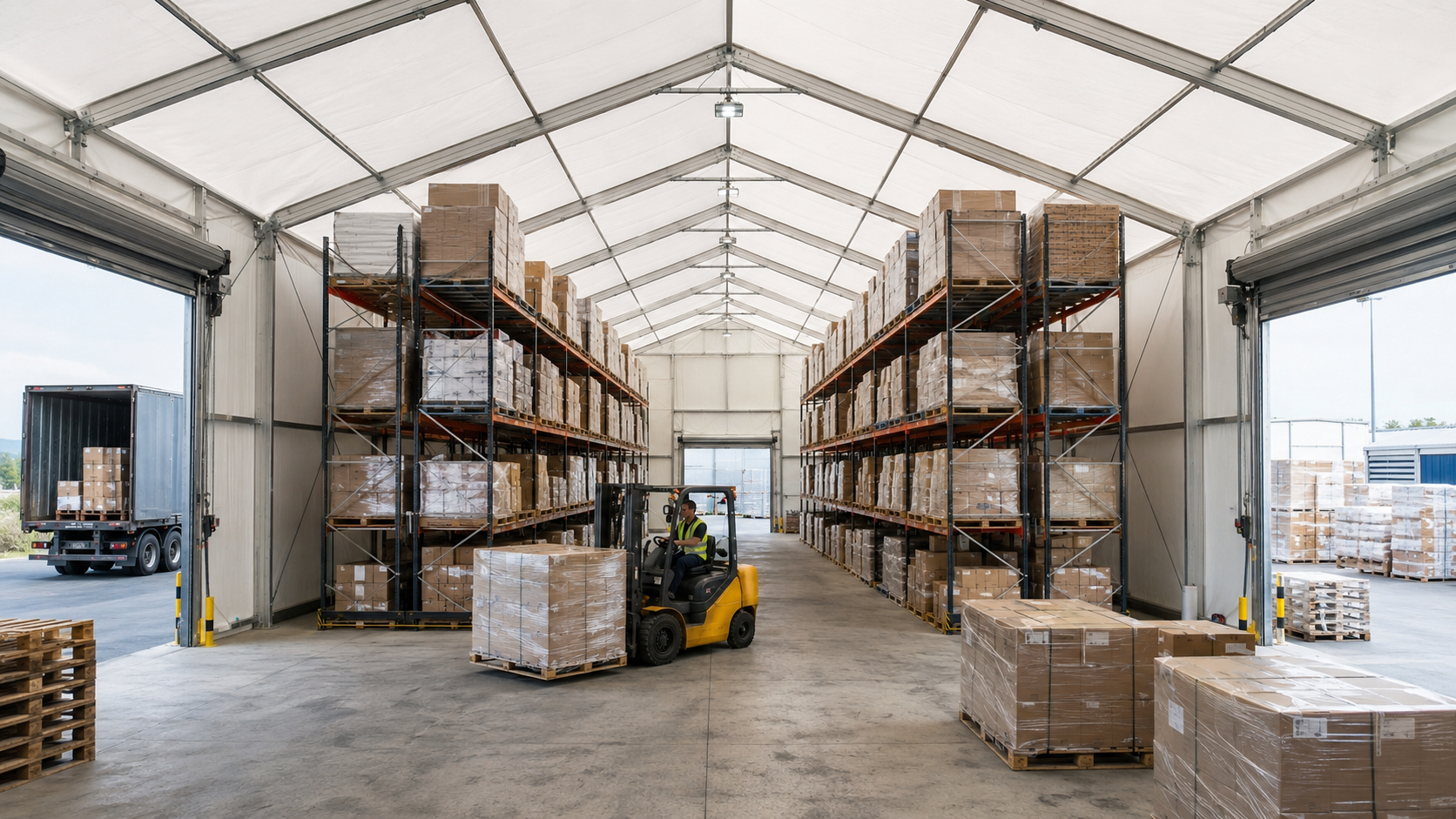
Aluminum alloy profiles are significantly lighter than structural steel sections of similar size. For a tent buyer, lower frame weight makes transport, site handling, and assembly easier. Components can often be moved with smaller equipment, and in some cases crews can handle sections manually. A steel frame, by contrast, usually requires more lifting capacity, stronger packing, and more careful coordination on site.
Lower component weight is especially valuable for rented venues, temporary event back-of-house areas, and multi-use warehouse structures that may be dismantled and relocated. If a tent is expected to move between sites, aluminum profiles are usually more practical to manage over the full service life.
Corrosion Resistance and Maintenance
Aluminum naturally forms a protective oxide layer, which gives aluminum frame tents good resistance to rust and corrosion. Steel, on the other hand, generally needs galvanizing or protective paint to prevent oxidation. Even with a protective finish, steel can rust where the coating is scratched, at bolted connections, or near cut edges.
This difference matters for warehouses in humid locations, event tents used near the coast, and structures used in agricultural or industrial environments where moisture and chemicals are present. An aluminum frame reduces routine corrosion maintenance compared with unprotected steel, although buyers should still inspect all metal components regularly.
Installation Speed and On-Site Work
Aluminum frame tents are normally supplied as prefabricated modular assemblies. The frame consists of aluminum alloy profiles, connectors, and a fabric cover system that can be installed and dismantled without welding on site. The modular approach is designed for rapid installation and helps owners respond quickly to shifting storage or event needs.
Steel structures may also be prefabricated and bolted, but the higher weight of steel sections often makes the assembly process slower and more dependent on lifting equipment. For temporary warehouses and event production schedules, installation speed is often a deciding factor.
Clear-Span Capability and Interior Layout
Clear-span design is one of the main reasons buyers choose aluminum frame tents for warehouses and events. Instead of locating support columns inside the usable area, the frame can be configured to create a wide, uninterrupted interior space. This is valuable for pallet racking, vehicle circulation, sports courts, catering lines, registration desks, staging, and other layouts where columns would block movement.
Steel truss systems can also create wide spans, but the larger structural members and heavier foundations can increase installation complexity. For semi-permanent applications, the column-free interior of an aluminum frame tent is often easier to plan around. Shoulder Tent's aluminum frame product line includes models S30-1, S32, S45-1, S45-2, and S60-1 for wedding, event, sports, and warehouse tent applications.
Wind and Snow Load Performance
Every large tent should be designed to resist the expected wind and snow load for its location. Buyers should always ask the supplier for the exact structural design values used in the engineering calculation.
The aluminum frame tent from Shoulder Tent, for example, is designed with a maximum wind load of 100-120 km/h and snow load up to 1.9 kN/m². These are verified product specifications that give a practical sense of what an aluminum profile structure can handle when installed correctly. Steel frame performance varies by beam size, wall thickness, connection design, and foundation type, so no universal number can be applied to all steel systems.
Important note: wind and snow resistance depends not only on the frame material but also on cover quality, anchoring, foundation, sidewall configuration, and site conditions. Ask the supplier to provide load calculations and installation requirements for your specific project.
Lifecycle Expectations
Available industry data compiled by Everich Outdoor indicates that aluminum alloy frames typically have a service life of 15-20 years, while PVC-coated fabric covers last about 5-8 years under standard outdoor conditions. Steel can also deliver long service life when properly galvanized and painted, but corrosion maintenance often becomes the main long-term cost driver.
When comparing quotes, it is useful to look beyond the initial frame price. Consider transportation cost, foundation work, crane hire, installation labor, maintenance time, and how easily the structure can be moved or modified.
Aluminum vs Steel Frame Tent Comparison Table
| Comparison Criteria | Aluminum Frame Tent | Steel Frame Tent |
|---|---|---|
| Frame weight and handling | Lighter components; easier transport and on-site handling | Heavier sections; usually requires more lifting capacity |
| Corrosion resistance | Aluminum alloy profiles provide strong resistance to rust; lower routine corrosion maintenance | Needs galvanizing or protective paint; rust can be a risk if coating is damaged |
| Installation speed | Prefabricated modular assembly; rapid installation and dismantling | Installation can be slower and more dependent on lifting equipment |
| Interior layout | Can be designed for column-free clear-span space | Wide spans are possible but often with heavier trusses and foundations |
| Example load specification | Shoulder Tent aluminum frame: wind load 100-120 km/h; snow load up to 1.9 kN/m² | Depends on beam design, coating, and project engineering |
| Typical service life | Aluminum frame generally 15-20 years; cover 5-8 years (industry data) | Can be long-lasting if protected from corrosion; depends on maintenance |
| Best suited for | Temporary and semi-permanent warehouses, events, sports venues, relocatable facilities | Fixed installations where heavy foundations and permanent erection are planned |
This table is a material-level comparison. Actual performance depends on the specific engineering, materials, installation team, cover quality, and compliance with applicable standards.
Why Aluminum Frame Tents Fit Temporary Warehouses and Event Back-of-House
Warehouse and Storage Applications
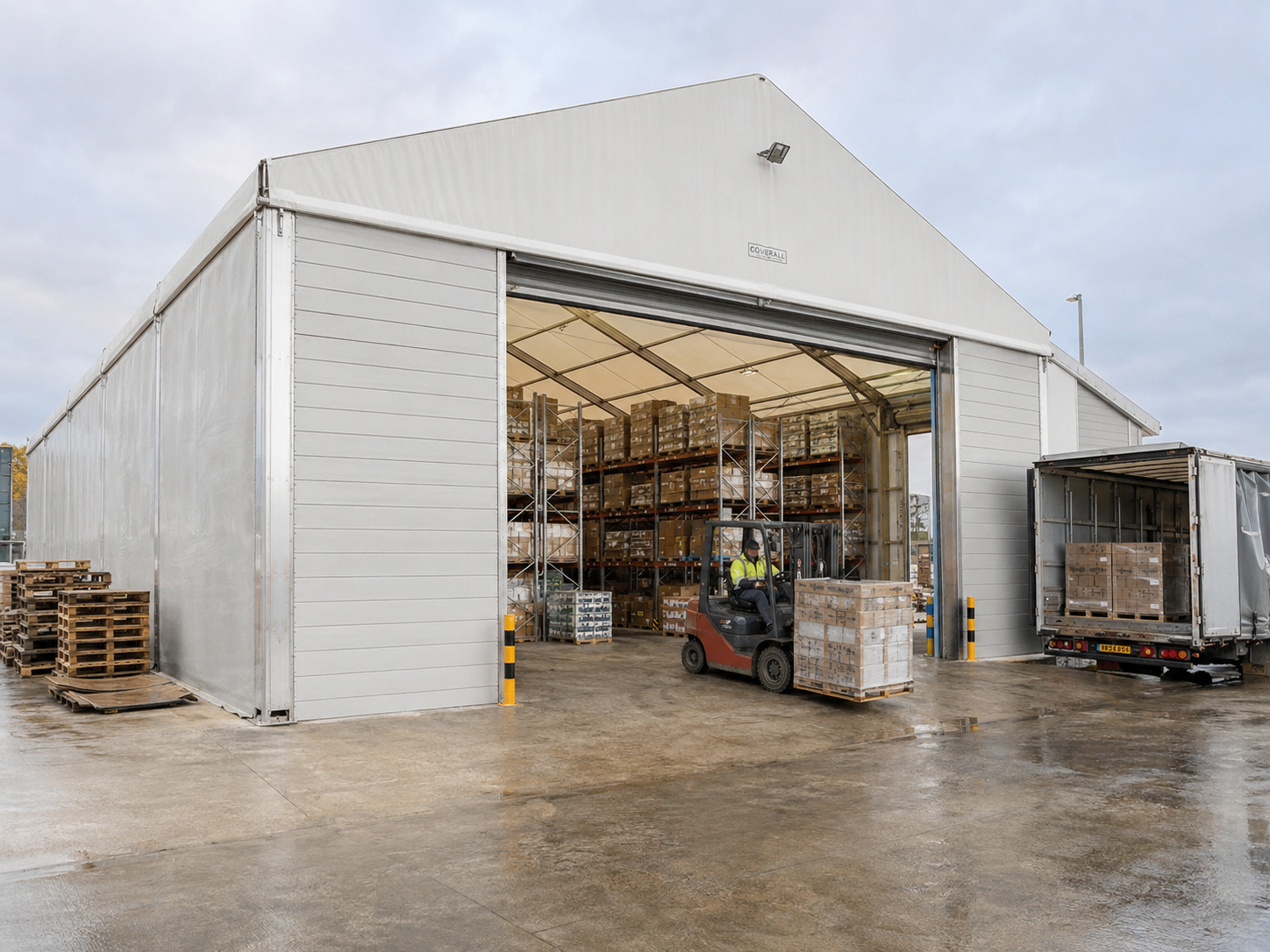
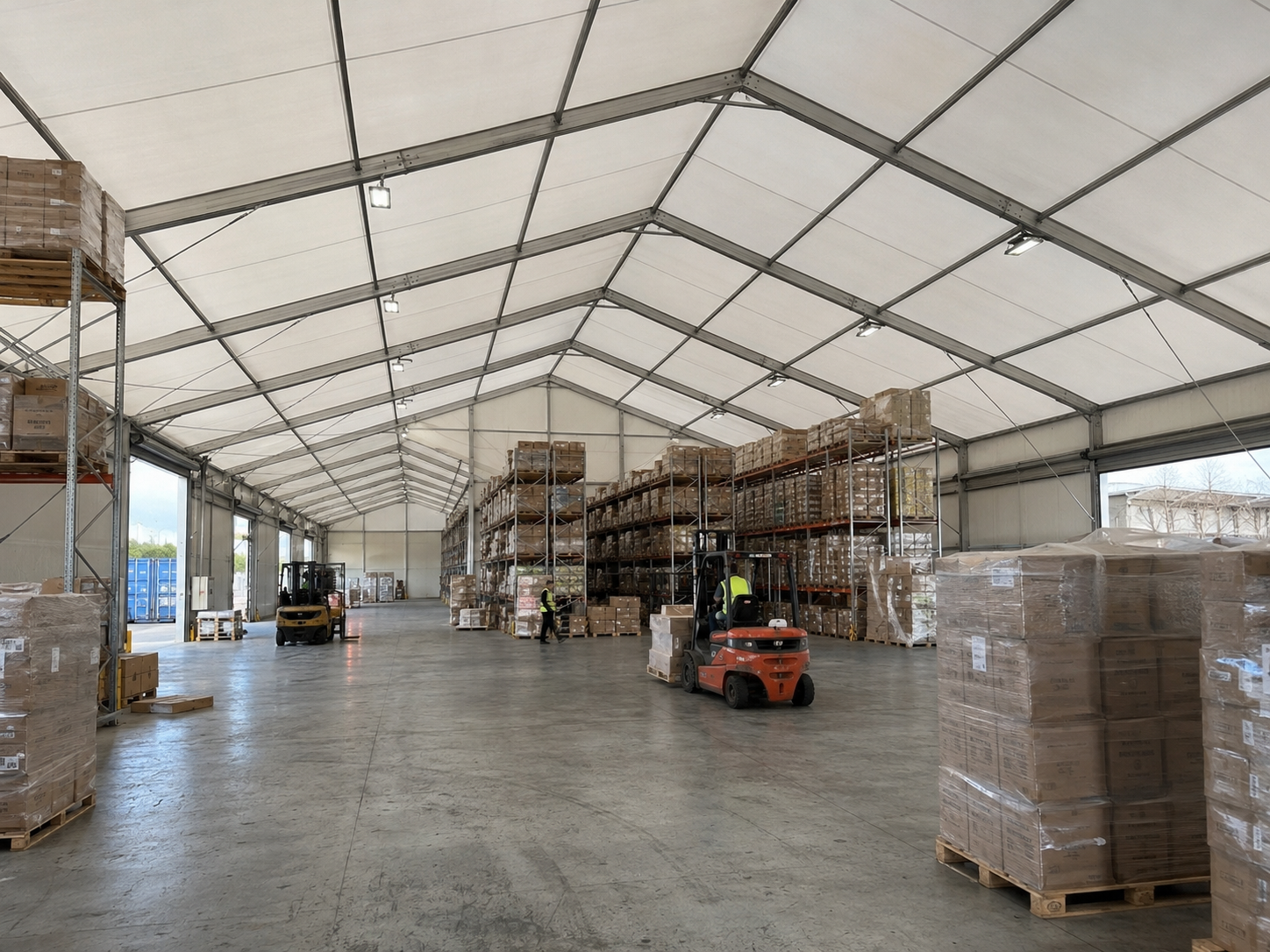
Warehouse operators often need overflow storage, distribution space, or assembly areas without waiting for a permanent steel building to be constructed. An aluminum frame warehouse tent can provide a waterproof, wind-resistant structure quickly. The design also supports semi-permanent use, which fits locations where land ownership, permits, or business planning may change.
The same structure can be fitted with custom doors and loading openings, sidewalls, ventilation, insulation, and lighting systems. These accessories are commonly specified for temporary warehouse tents because they make the structure usable in daily logistics operations. Shoulder Tent's aluminum frame tent is designed for warehousing & logistics, industrial manufacturing, agricultural storage, exhibition & events, sports venues, and hospitality or resort use.
Event Back-of-House Applications
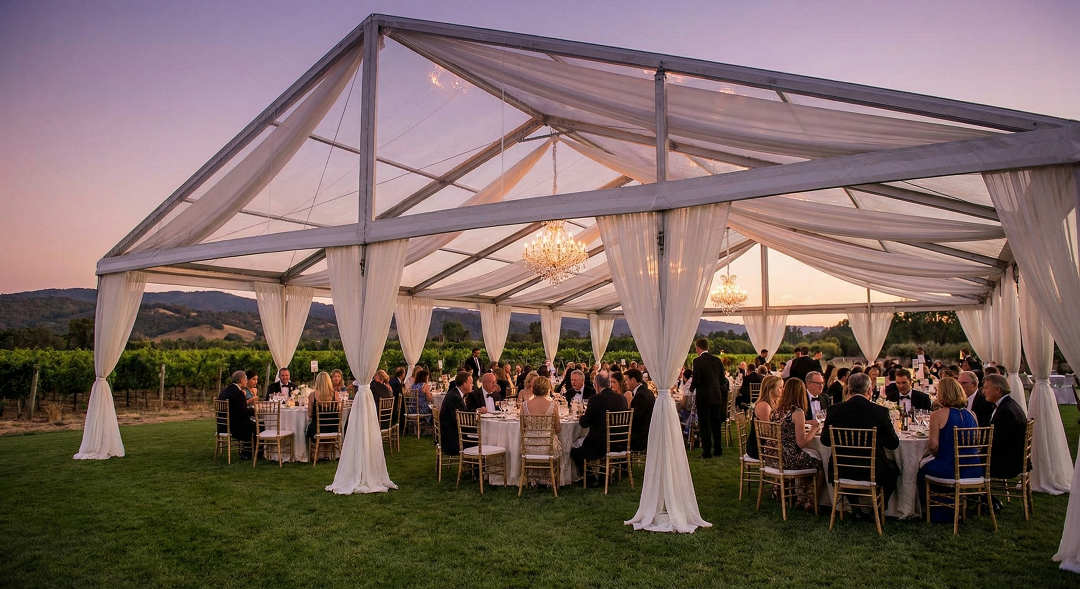
Event planners rarely need a permanent building. They need space that can be delivered, installed, staffed, and removed on a tight schedule. Aluminum frame event tents can house catering kitchens, dressing rooms, registration areas, VIP lounges, equipment storage, and operations offices behind or beside the main event floor.
Clear-span interior space is particularly useful for event back-of-house operations because there are many moving people, trolleys, cables, and supplies. A tent without internal support columns simplifies traffic flow and reduces safety hazards. The modular aluminium profile system also allows the tent to be reused for different event sizes and layouts.
Step-by-Step Buyer Framework for Frame Selection
Use the following steps to compare aluminum and steel frame tents for a specific warehouse or event project.
- Define the function and expected duration. A temporary event space and a five-year logistics warehouse have different design priorities.
- Calculate the required clear-span width, length, and eave height. This determines whether the project needs a standard aluminum tent model or a custom structure.
- Check the local code environment. For temporary tents in Europe, EN 13782:2015 is the relevant structural safety standard; in the United States, fabric compliance with NFPA 701 is commonly required.
- Verify wind and snow load requirements for the installation site. Compare these values with the supplier's stated design loads, such as 100-120 km/h wind load and 1.9 kN/m² snow load for Shoulder Tent's aluminum frame tents.
- Assess site access and ground conditions. Heavier steel structures may need stronger foundations; aluminum structures can sometimes use anchors or ballast systems with less ground preparation.
- Review installation and relocation plans. Ask whether the frame is modular, whether welding is required on site, and what lifting equipment is needed.
- Price the full ownership cost, not only the frame. Include transport, foundation, installation, maintenance, and possible relocation expenses.
Use Case Examples for Aluminum Frame Tents
Large aluminum frame tents support several application categories commonly specified by importers, distributors, and end users.
Temporary and semi-permanent warehouse space. Aluminum frame tents can extend existing factory or warehouse capacity. They are useful for seasonal products, raw materials, equipment, maintenance workshops, and logistics staging areas.
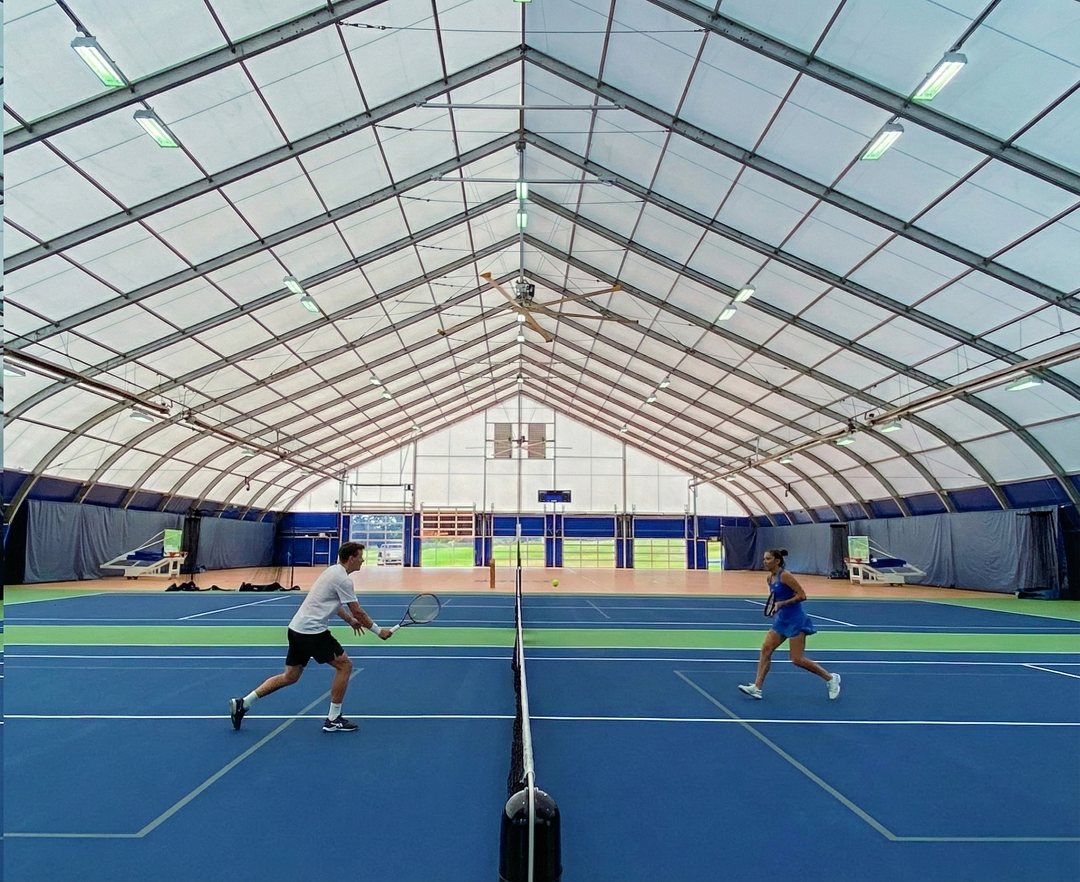
Sports venues. A clear-span aluminum tent can cover pickleball courts, padel courts, tennis courts, training halls, and seasonal sports facilities. The absence of internal columns keeps the playing area free from obstruction.
Event back-of-house and hospitality. Aluminum event tents provide covered space for catering, guest registration, VIP areas, equipment storage, staff areas, and large outdoor weddings. Because they can be installed and dismantled relatively quickly, event rental companies can reuse the same tent across multiple sites.
Exhibitions and commercial projects. Industrial exhibitions, product launches, dealer events, and temporary showrooms also rely on large aluminium frame tents when permanent halls are unavailable or too expensive.
What Buyers Should Know About Sourcing Aluminum Frame Tents
To understand how an aluminum frame tent manufacturer proves its capability, buyers can look at production scale, project history, and product breadth. Shoulder Tent, for example, was established in 2009 and operates a manufacturing facility covering 20,000 square meters with approximately 200 employees. Its annual production capacity is 1,000 units, and export business accounts for 80% of total sales.
Shoulder Tent has delivered large tent products to clients across many countries and regions, with major markets in Europe, the Middle East, Africa, Southeast Asia, and South America. The company supplies a range of aluminum-frame tents, including A-Shape, Arc/Curved, APS hybrid, Dome/geodesic, Mixed/polygon/high-peak, and Pagoda/Gazebo structures. It also offers an R&D center, engineering team, custom design support, and technical consultation, which help importers adapt standard tents to local requirements.
Buyers do not need to rely only on marketing statements. They can ask a manufacturer for product specifications, drawings, load values, component details, installation instructions, and references from previous warehouse or event projects.
Aluminum Frame Tent vs Steel Frame Tent FAQ
Here are answers to common questions asked by buyers comparing aluminum frame tents and steel frame tents.
1. What is the main difference between an aluminum frame tent and a steel frame tent?
Aluminum frame tents use aluminum alloy profiles as the structural frame. They are lighter, naturally resistant to rust, and well suited for modular installation, dismantling, and relocation. Steel frame tents rely on structural steel sections, which can be very strong but are heavier and usually need more lifting capacity and corrosion protection.
2. Are aluminum frame tents strong enough for warehouses and events?
Yes, when designed correctly. A relevant example is the aluminum frame tent from Shoulder Tent, which is engineered for a maximum wind load of 100-120 km/h and snow load up to 1.9 kN/m². Actual performance still depends on installation, anchoring, cover quality, and local site conditions.
3. Why do buyers choose aluminum frame tents rather than steel for temporary facilities?
The main reasons are lower component weight, faster installation, better corrosion resistance, and easier relocation. These benefits matter when a warehouse or event structure is expected to be assembled, used for a season or a limited period, and later moved to another site.
4. What should an importer check when evaluating aluminum frame tent suppliers?
Buyers can check company history, manufacturing scale, production capacity, export experience, product range, and engineering support. As an example, Shoulder Tent was established in 2009, employs around 200 staff in a 20,000-square-meter factory, and has an annual production capacity of 1,000 units. It exports to Europe, the Middle East, Africa, Southeast Asia, and South America.
5. Which projects are best suited to an aluminum frame tent?
The aluminum frame tent is suitable for warehousing and logistics, industrial manufacturing, agricultural storage, exhibitions and events, sports venues, weddings, and hospitality projects. It is practical for temporary and semi-permanent structures where clear-span space, weather protection, and flexible installation are required.
Verifying Performance Before You Order
The choice between aluminum and steel should not be made only by looking at a brochure. Buyers should ask for the following documents before ordering a large tent: structural drawings, wind load and snow load calculations, anchor and foundation recommendations, cover specifications including flame-retardant properties, and a written statement of the applicable standard.
For European projects, EN 13782:2015 is the standard that governs structural stability of mobile, temporary installed tents. In the US market, NFPA 701 is commonly used to verify fire performance of fabrics. Even if the tent is installed in another market, these standards are useful references because they show how the supplier approaches structural safety.
Final Comparison: Making the Decision
Both aluminum and steel frame tents can deliver functional large-scale enclosures. The decision comes down to the buyer's project timeline, site conditions, relocation needs, and total operating cost. For warehouses and event back-of-house applications that require speed, flexible layout, corrosion resistance, and a clean column-free interior, aluminum frame tents are an excellent choice.
Steel remains a reasonable material for some fixed, permanent applications, especially where a heavier foundation is accepted and relocation is not planned. But when buyers need a temporary or semi-permanent structure that can be installed quickly and shifted when business changes, the aluminum frame tent has clear practical advantages.
Get More Information from Shoulder Tent
Shoulder Tent offers a broad range of aluminum frame tents for warehouse, sports, wedding, event, and commercial applications. If you are comparing frame options or preparing a specification, download the company brochure for a detailed product overview.
Download brochure: Shoulder Tent Company Introduction PDF
Email: info@shouldertent.com
Phone/WhatsApp: +86 158 1850 8822
Website: www.shouldertent.com
Management Center Shenzhen: No. 4703B, West Tower, Galaxy Twin Towers, Shenzhen, China
Sources for market and industry data in this article: Rethinking The Future, Shelter Structures, OEC, Everich Outdoor, CEN/NFPA standards.
Have Questions or Need More Details?
Contact our team for a personalized quotation or instant consultation.
Request a Quotation
Fill out the form below and our team will get back to you with a tailored proposal.
WhatsApp Direct Chat
Prefer to chat in real-time? Message us on WhatsApp for instant assistance & quick answers.
- Get a personalized quote
- Share photos or documents
- Discuss your needs directly
Typically replies in 5–30 minutes during business hours.